
McKinsey says robots are getting smarter fast, but the payback today is in repetitive, measurable work in the sites you already run. Here is a five-question test to find your first robot job.
The robot videos that go viral are humanoids folding laundry or dancing on stage. The robots that actually earn money are far less photogenic: arms on production lines, carts moving pallets, machines checking parts for defects. McKinsey’s Technology Trends Outlook 2026 draws exactly that line, and it matters for any business owner wondering whether robots belong in their operation.
This article gives you the short version: where robots pay for themselves today, where they do not yet, and a five-question test you can run on your own operation before you spend a dollar.
- AI is giving robots the ability to see, reason and adapt, so they are moving beyond fixed factory tasks into warehouses, hospitals, labs and farms.
- But McKinsey rates the trend at the experimentation stage overall. Industrial robots are mature; humanoids and general-purpose service robots are early.
- The clearest near-term wins are repetitive, measurable jobs in structured spaces: materials handling, inspection and lab automation.
- Most of the value will come from adding robots to the sites you already run, and paying per use can take the capital risk out of the first step.
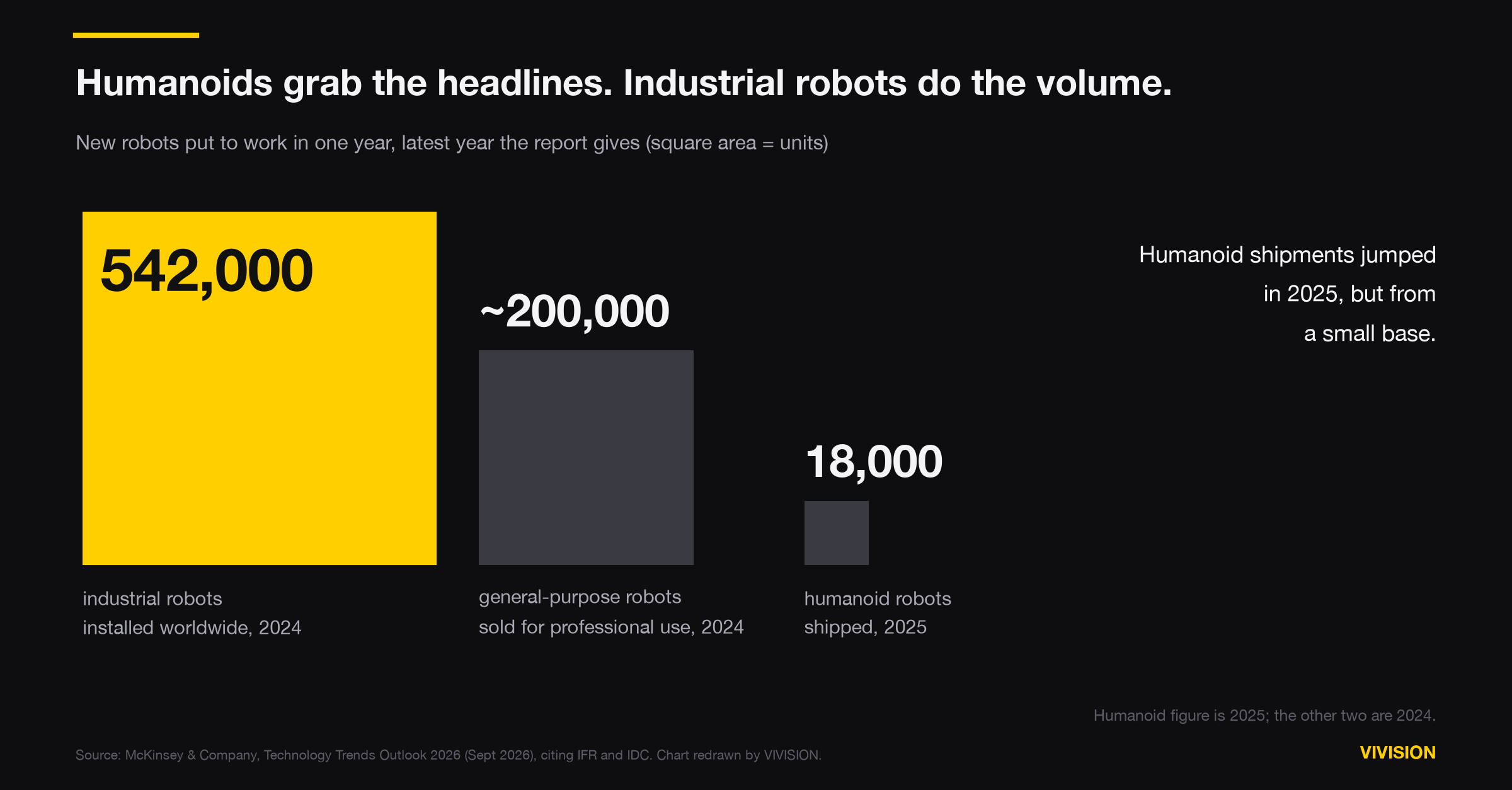
The report estimates roughly five million industrial robots are now in operation worldwide, with 542,000 put into service in 2024 alone. Humanoid shipments rose sharply in 2025 to 18,000 units, and IDC data cited by McKinsey puts humanoid revenue up more than 500 percent year on year to $440 million. Fast growth, but from a small base. The volume, and the proven payback, is still in conventional automation.
Three robot myths, and what the report actually says
Robots pay off first where the work is predictable
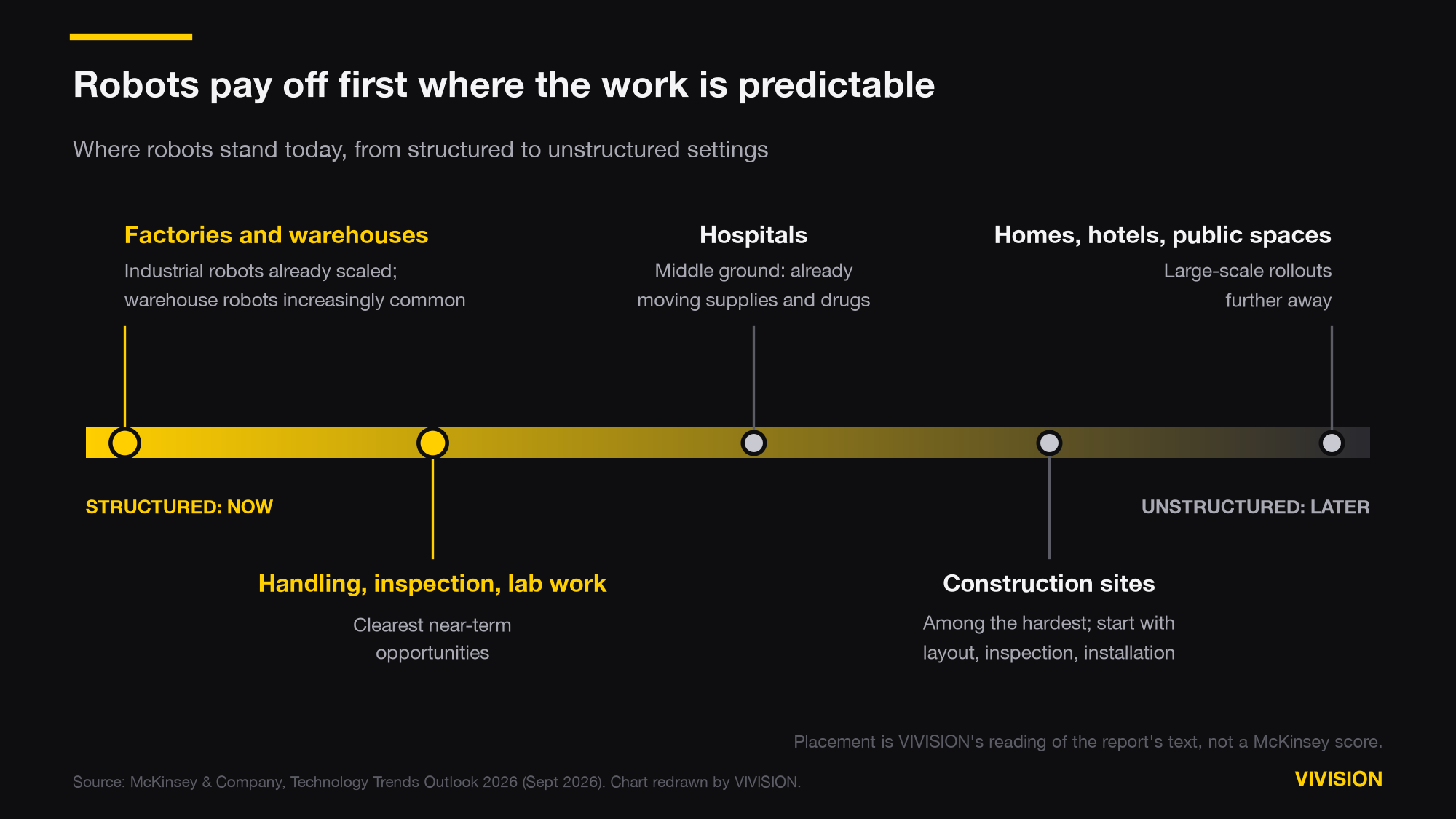
McKinsey’s near-term picture is specific. The clearest opportunities are materials handling, inspection and laboratory automation. What these jobs share, the report notes, is labor constraints, outputs you can measure, and enough structure in the environment for a robot to work reliably. Hospitals sit in a middle ground: more controlled than a home, less controlled than a warehouse, and already using robots to move supplies and drugs. Homes, hotels and public spaces are further away.
The five-question robot-ready test
VIVISION built this from the conditions McKinsey links to near-term success. Score one point for each clear yes.
| 1 | Is the task repetitive? The same motion, the same objects, many times a shift. |
| 2 | Can you measure the output? Units moved, parts inspected, samples run, errors caught. |
| 3 | Is the space structured? Fixed layout, marked routes, predictable traffic. |
| 4 | Is the job hard to staff? Open shifts, high turnover, overtime you cannot sustain. |
| 5 | Do you have someone to own it? A person who can connect the machine to your systems, safety rules and daily routine. |
The test and scoring bands are VIVISION’s own tool. Question 5 reflects McKinsey’s finding that the harder robotics constraint is finding people who can connect AI with hardware, controls and deployment.
Buy the robot, or rent the work?
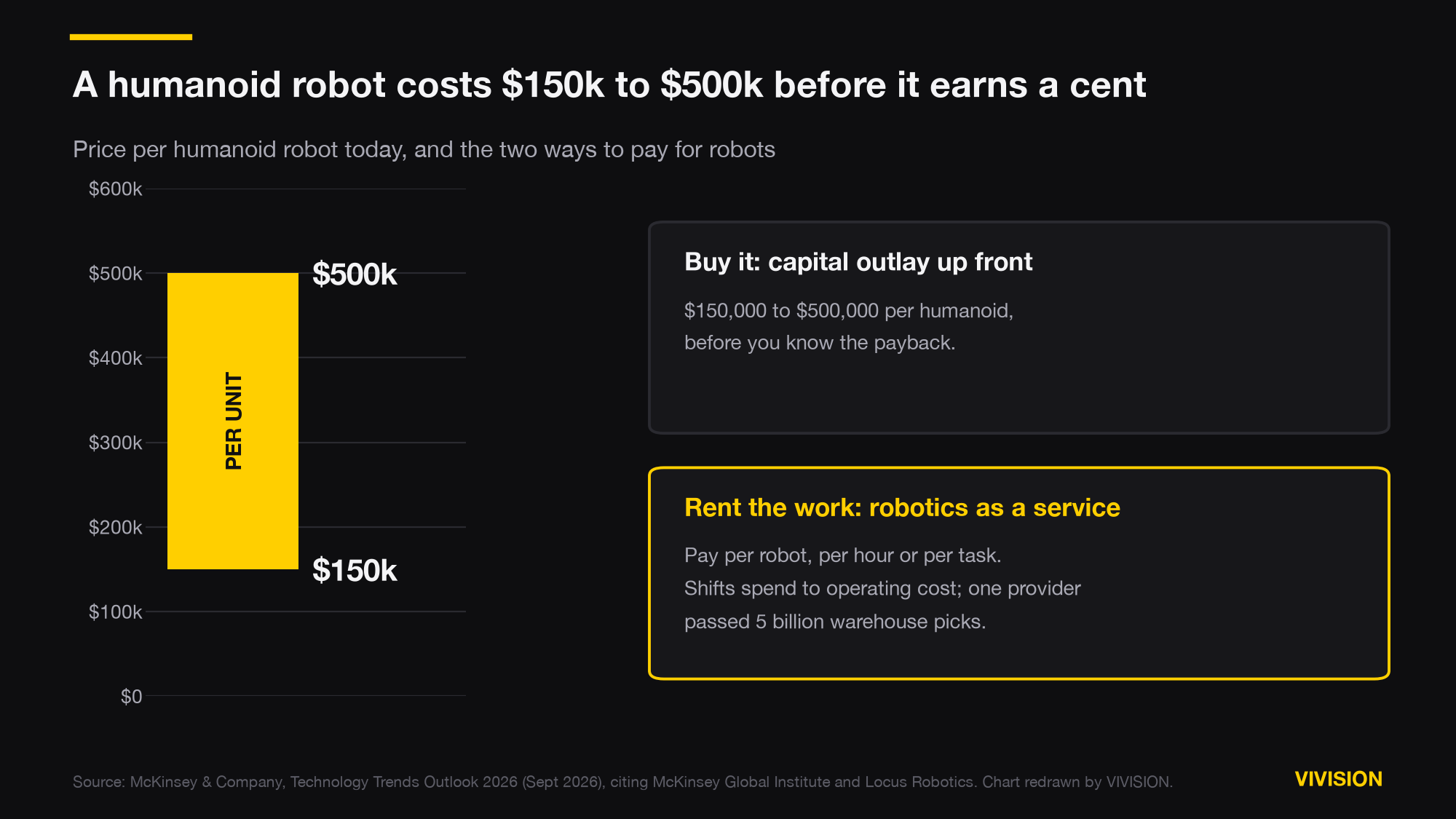
Up-front cost is one of the big structural barriers the report names. Citing the McKinsey Global Institute, it puts humanoid robots at $150,000 to $500,000 per unit today. Robotics as a service changes the math: you pay per robot, per hour or per task, which moves the spend from capital to operating cost. McKinsey points to Locus Robotics passing five billion warehouse picks across its customers as a sign the model can scale.
There is a second benefit the report points out. Under a service model, the provider gets data on usage and failures, you get data on performance, and both sides have a direct reason to push uptime and reliability higher.
Four things to settle before the robot arrives
McKinsey lists safety, liability, cybersecurity and insurance frameworks among the key uncertainties for more autonomous robots. The checklist wording is VIVISION’s.
From curiosity to a decision you can defend
We are a small business. Is any of this for us?
Yes, if you run a warehouse, a production line, a lab or any site with repetitive handling or checking work. The report says pay-per-use models could open robots to organizations that cannot justify a large up-front commitment before the return is clear.
Should we wait for humanoids to get cheaper?
Not if a simpler robot fits the job today. McKinsey expects logistics and manufacturing to be the first humanoid adopters over the next decade. In the meantime, arms, carts and mobile manipulators are proven, and the skills you build with them will carry over.
Is money still flowing into robotics?
Yes. The report says equity investment reached $19.5 billion in 2025, the highest level yet, and job postings grew 12 percent year on year. That means more vendors and more choice, and also more hype to filter.
What is the biggest reason robot projects stall?
In our experience, it is integration, not the robot. McKinsey makes a related point: wide adoption depends on the economics of deployment and on fitting robots into existing systems, and the scarcest people are those who connect AI to hardware and operations.
VIVISION runs a vendor-neutral robot readiness review. We walk your site, score your candidate jobs, build the baseline, and model buy versus pay-per-use against the same output. Then we help you write a pilot with a clear success bar and exit terms, and plan who will own it once it is running.
You get a straight answer on whether robots will pay for themselves in your operation this year, and if not, what to fix first.
Wondering if a robot would pay off in your operation?
Tell us about the one job you would automate first. We will tell you honestly if it passes the test.
Source: McKinsey & Company, “Technology Trends Outlook 2026” (Sixth edition, September 2026), Future of robotics chapter. All statistics are McKinsey’s, including sources the report cites such as the International Federation of Robotics, IDC, the McKinsey Global Institute and Locus Robotics. Charts were redrawn by VIVISION from the published figures. The readiness spectrum placement, the “VIVISION insight” sections, the five-question test, the pre-signing checklist, the 90-day plan, the quick-answer opinions and “what we do for clients” are VIVISION’s own views and are not McKinsey’s.
Copyright in the original report belongs to McKinsey & Company. Cover photo: Salvador Escalante on Unsplash.