
McKinsey shows AI-run experiment loops cutting R&D costs and drawing record investment. You don't need a lab to use the method: here is how any product business can shorten its own test cycle.
Here is a result worth stealing. Ginkgo Bioworks gave an AI model access to a cloud lab in Boston and let it design the experiments. After six rounds of test, measure and adjust, the cost of the process they were working on came in 40 percent below state-of-the-art practice. McKinsey highlights the case in its Technology Trends Outlook 2026.
You do not need a lab to use the lesson. The win did not come from a smarter scientist or a bigger budget. It came from a faster loop. This article shows how that loop works, why investors are piling into it, and how a business that makes products, menus, services or software can run the same play.
All four figures: McKinsey, Technology Trends Outlook 2026, AI for scientific discovery and engineering chapter.
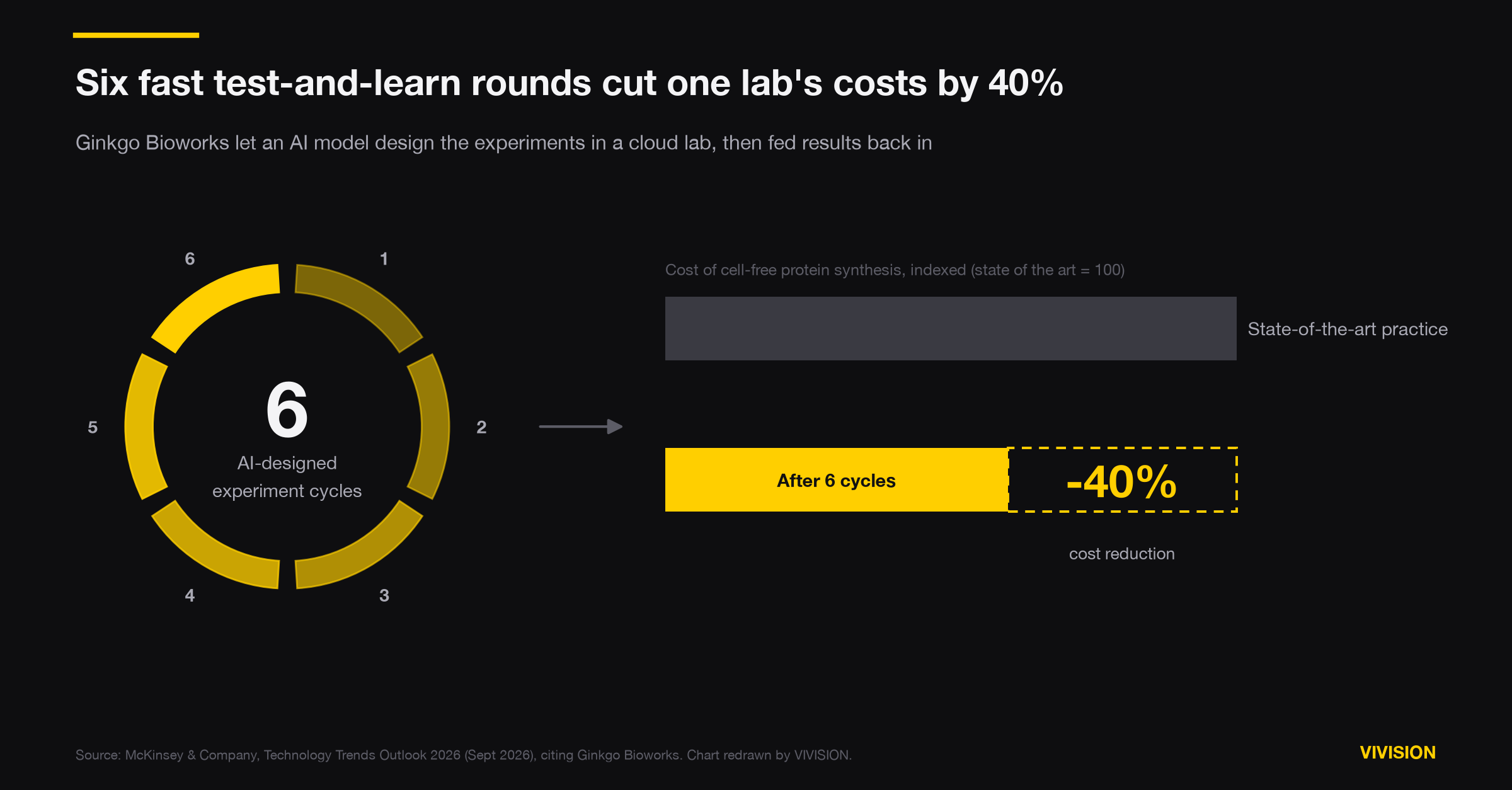
The lab did not get smarter. The loop got shorter.
For decades, research has run in a straight line: someone has an idea, a team designs a test, the test runs, someone analyses the results weeks later, and the next idea starts from there. McKinsey’s report describes leading research teams moving to a closed loop instead. AI models propose what to try, automated systems run the experiments, and software feeds the results straight back into the models for the next round.
That matters because research has been getting slower and more expensive. In biopharma, the report notes, the tendency for drug discovery to get slower and more expensive over time, despite better technology, has a name: Eroom’s Law (Moore’s Law spelled backwards). Bringing a new drug to market still often takes more than ten years and costs an average of $1.3 billion to $2.6 billion. Bending that curve is why the money is moving.
The four-step summary is VIVISION’s simplification of the closed-loop approach McKinsey describes. The report notes humans are still important for approval and verification.
Six months of 2026 already beat all of 2025
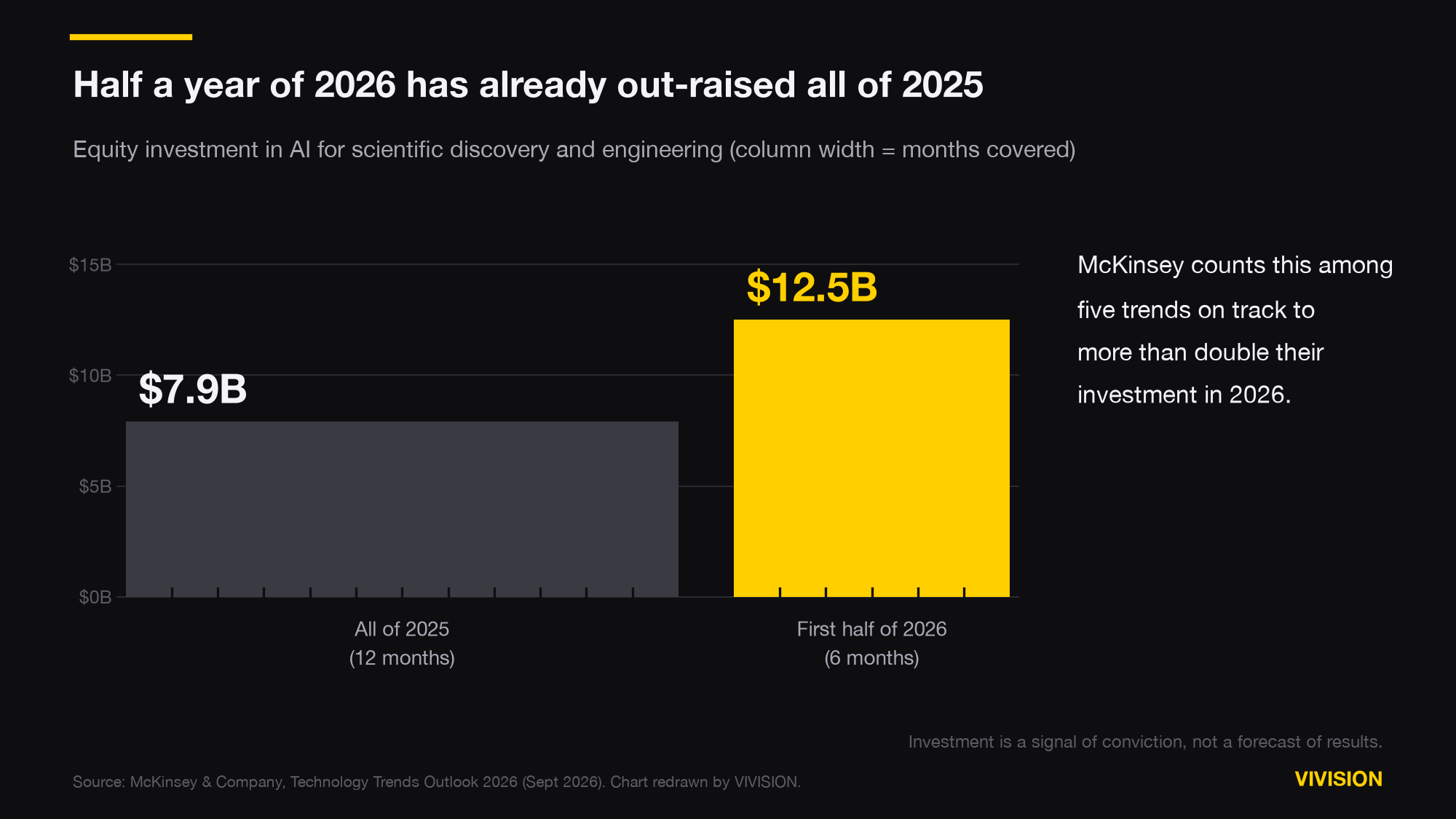
McKinsey measured $7.9 billion of equity investment in AI for scientific discovery and engineering in 2025, and $12.5 billion through the first half of 2026. It names this as one of five trends on track to more than double their investment this year. The deals it cites span AI-native drug discovery, materials science, and engineering platforms that use AI to stand in for slow, costly simulations.
What the lab version looks like in your business
| In the lab | In a growing business |
|---|---|
| Candidate molecules | Product variants, price points, offer bundles, recipe or formula tweaks |
| Simulation before the bench | A digital mock-up, a landing page test or a small regional trial before a full launch |
| Cloud lab you rent | Contract testing, outsourced prototyping, ad platforms that run split tests for you |
| Proprietary experimental data | Your sales history, returns, complaints, quality logs and past test results |
| Validation before clinical trials | The real-world check: safety, compliance, a paying customer saying yes |
The business equivalents are VIVISION’s analogies, not McKinsey’s.
Your test history is worth more than the model
The report is blunt that scientific data is a strategic asset, and that many organizations do not have enough of their own. Some are pooling data with partners, others are building automated labs mainly to generate it. McKinsey also says that to unlock value, organizations need to capture their own data, know-how and checking routines inside the AI workflows their experts actually use. One example it cites: MIT researchers trained a model on more than 23,000 materials synthesis recipes to help scientists find workable ways to make promising ideas real.
The hire you need speaks both languages
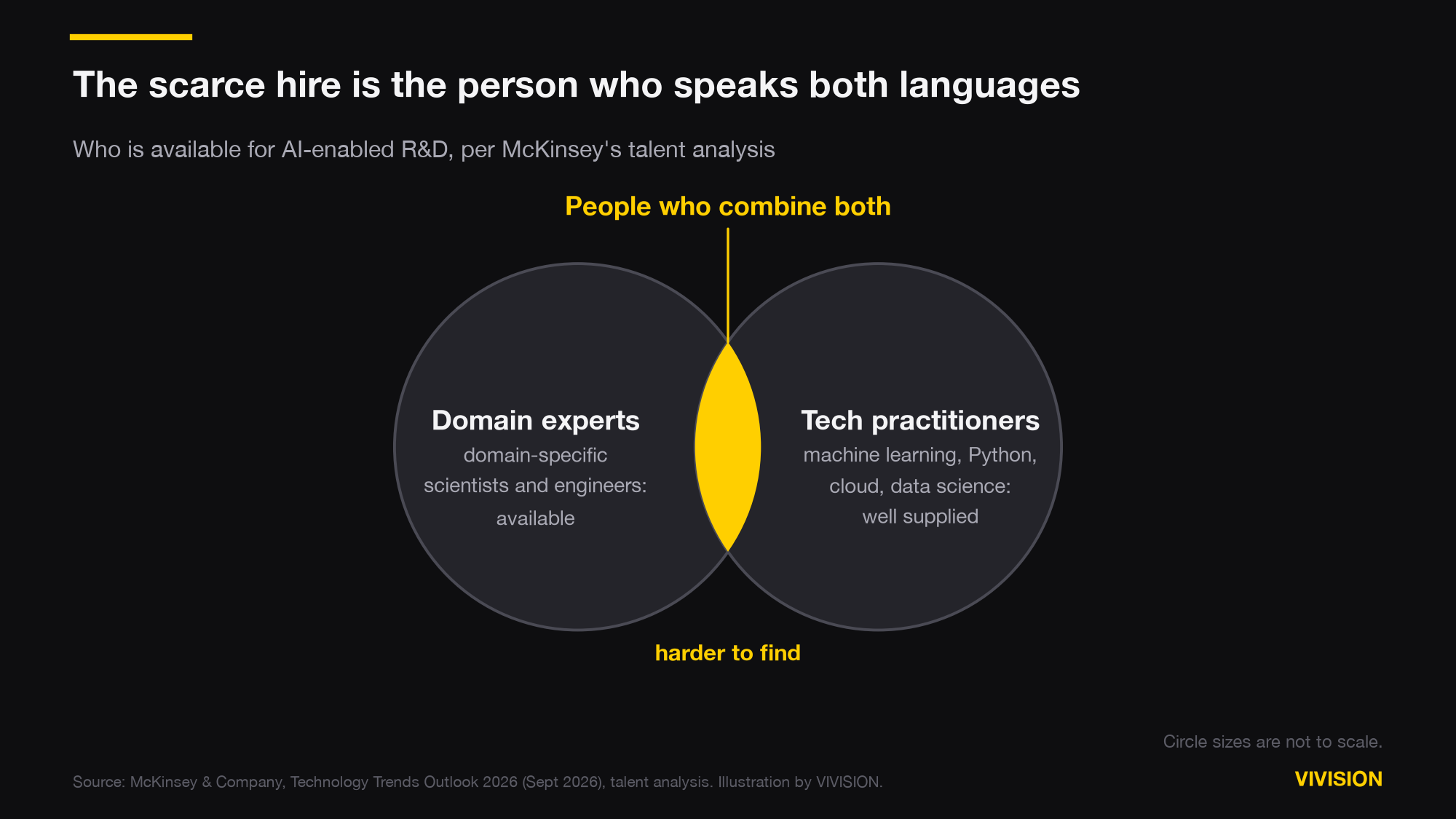
Job postings in this field fell by more than half from their 2022 peak, then rose 18 percent between 2024 and 2025, with machine learning engineers among the fastest-growing roles. McKinsey finds core skills such as machine learning, Python and data science are well supplied. The gap is elsewhere: domain experts and technology practitioners are both available, but people who combine the two are harder to find.
Three traps McKinsey flags, in plain terms
Paraphrased from the key uncertainties in McKinsey’s chapter. Headings are VIVISION’s.
We are not a science company. Why should we care?
Because the method transfers even if the molecules do not. Any business that improves a product by trying versions and checking results can shorten that cycle. Science is simply where the method is being proven first, with the most money behind it.
Does this mean AI replaces our product team?
No. McKinsey describes language models being used as coordinators that work alongside specialist tools and experts, not as replacements for them, and notes people remain important for approval and verification. Your team decides what is worth testing and what counts as a good result.
Is it too early to act?
For buying autonomous labs, probably yes; McKinsey scores adoption at the experimentation stage. For building the habit, no. Logging tests and shortening your own cycle costs little and makes you ready when the tools mature.
What should we measure?
Two numbers: how many days one test cycle takes from idea to result, and how many cycles you complete per quarter. If the first is falling and the second is rising, your loop is working.
VIVISION runs a test-and-learn sprint. We map how your team develops and improves products today, measure the real cycle time, and find where ideas wait. Then we set up the test log, choose where AI can propose or simulate options safely, and agree the human checks that stay in place.
You leave with one working loop, a baseline you can measure against, and a clear view of which AI design tools are worth paying for and which are not yet.
How long does one test cycle take in your business?
Tell us, and we will show you where the days are going and how to win them back.
Source: McKinsey & Company, “Technology Trends Outlook 2026” (Sixth edition, September 2026), AI for scientific discovery and engineering chapter. All statistics are McKinsey’s, including studies the report cites such as the Ginkgo Bioworks cloud-lab experiment and MIT materials research. Charts were redrawn by VIVISION from the published figures; the talent diagram is a VIVISION illustration of McKinsey’s finding. The four-step loop summary, the business translation table, the “VIVISION insight” sections, the quick-answer opinions, the Monday checklist and “what we do for clients” are VIVISION’s own views and are not McKinsey’s.
Copyright in the original report belongs to McKinsey & Company. Cover photo: Egor Myznik on Unsplash.