
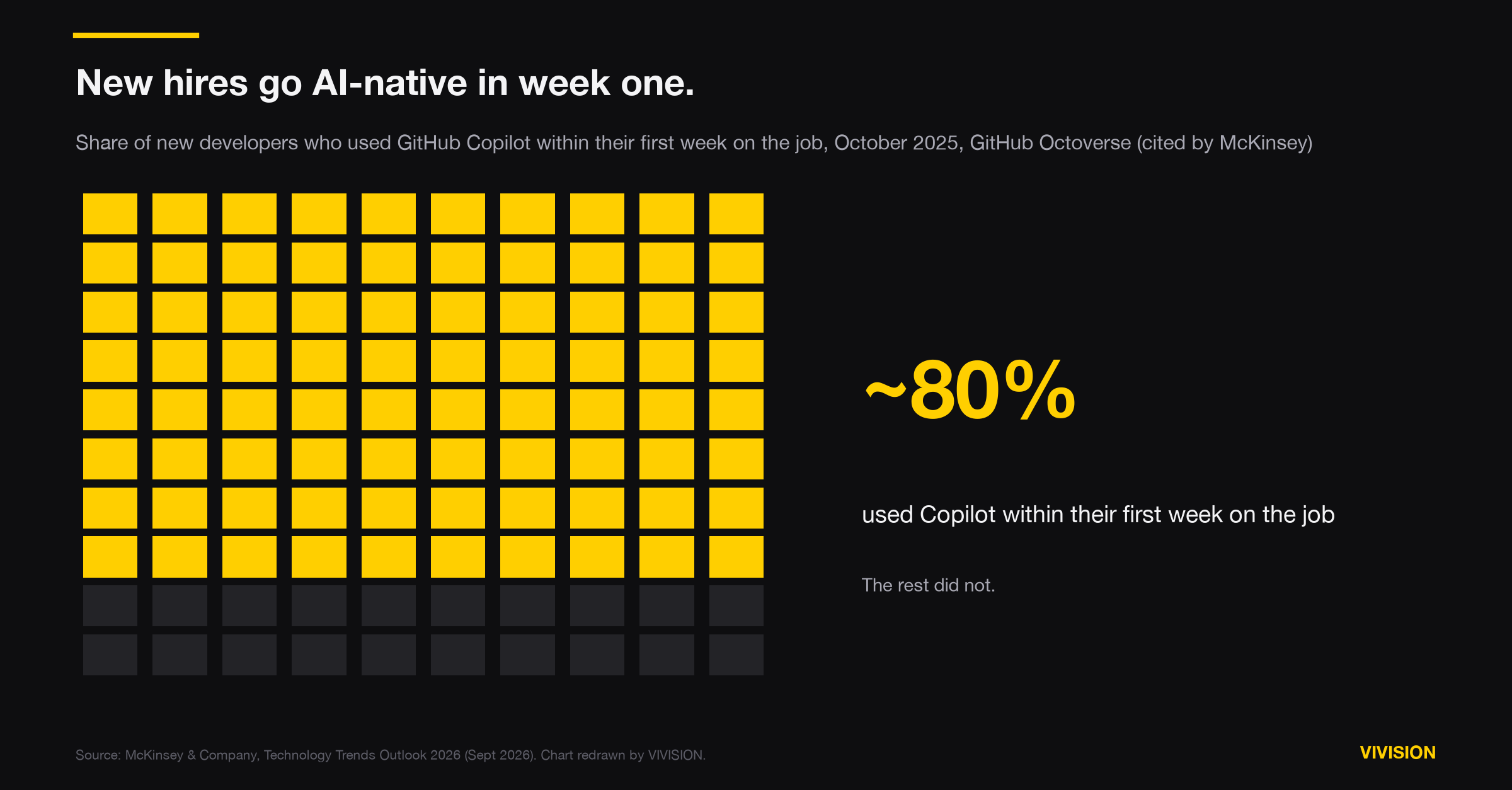
Nearly 80% of new developers go AI-native in their first week on the job, McKinsey reports. Here is the overlooked fix that turns that adoption into real business return.
McKinsey’s Technology Trends Outlook 2026 says agentic AI is becoming the connective tissue of the enterprise, changing not just tools but operating models. The tools spread on their own. The return does not show up on its own.
New hires arrive AI-native. Most org charts, budgets, and decision rights are still built for a world before agents. Close that one gap and the same AI spend starts paying off.
The tools moved in a week. Most companies still haven’t.
McKinsey cites GitHub data showing more than 1.1 million public repositories already run on an LLM software development kit, and that nearly 80% of new developers used Copilot within their first week on the job. That is not a rollout plan. It is just how a new hire now works, on day one, whether or not anyone told them to. McKinsey’s own framing is blunt: agentic AI is becoming the connective tissue of the enterprise, and that is reshaping infrastructure, governance, and workforce strategy, not just the tech stack.
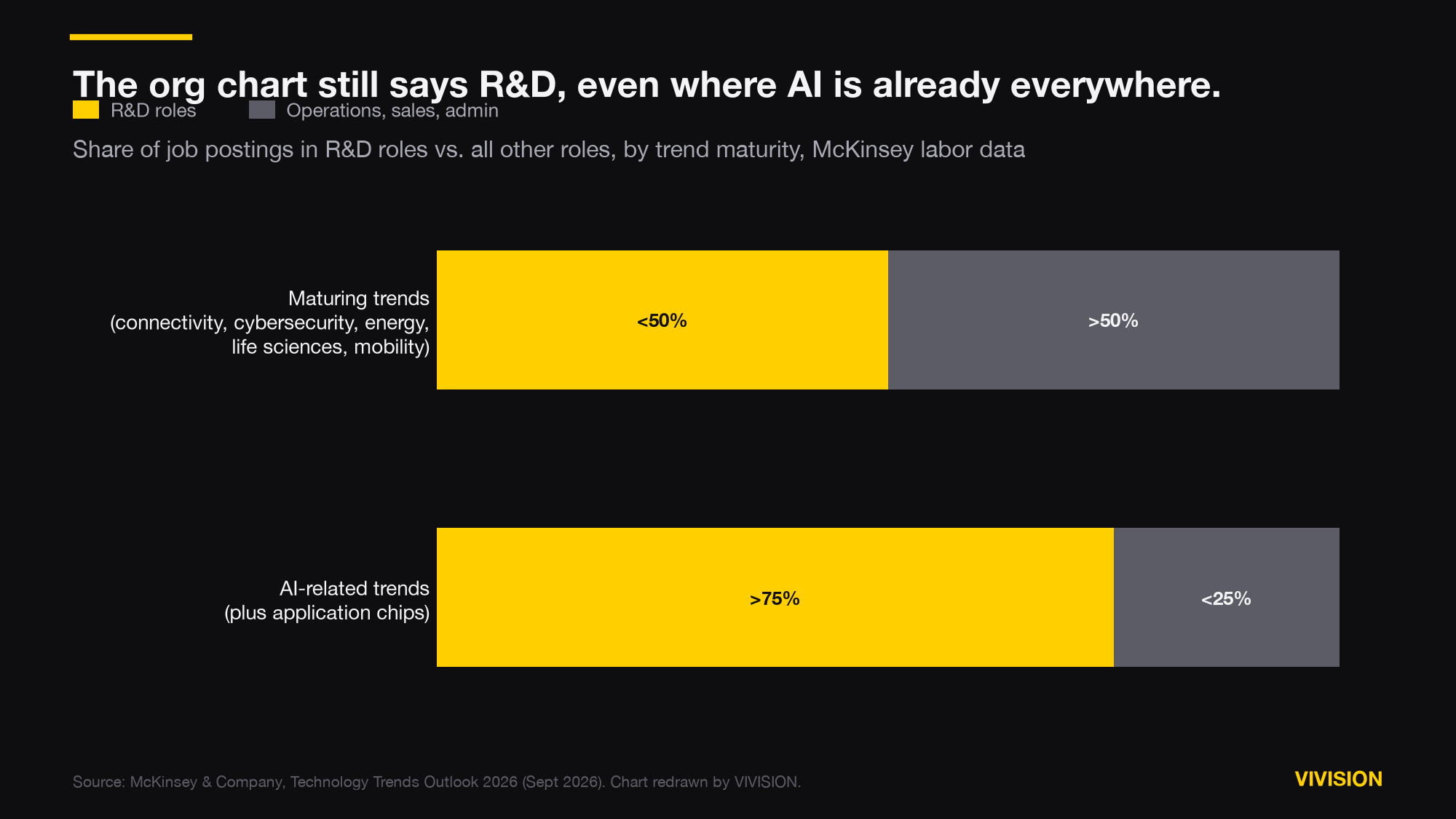
The hiring still looks like R&D, even where the tools are already everywhere.
McKinsey’s talent data shows the four AI-related trends, plus application-specific chips, still post more than 75% of their jobs in R&D roles: people building the thing. In trends already running commercially, like connectivity, cybersecurity, energy, life sciences and mobility, under half of postings are R&D; the rest are operations, sales and administrative roles that run the thing day to day. Most companies using AI today are hiring like they are still building it, not running it. The operating model hasn’t caught up to how the tool is actually being used.
Three things change. The tech stack is not one of them.
McKinsey’s own big question for leaders: how should organizations rethink operating models, governance and workforce strategy around agentic systems? Here is what we see moving in practice.
Team structure
McKinsey describes the shift toward smaller, highly leveraged “human-agent pods,” where a few people supervise fleets of agents instead of doing all the implementation themselves. McKinsey notes Salesforce said it would not hire additional software engineers in 2025 after reporting AI-driven productivity gains, an early signal of the shift.
Decision rights
Someone has to own what an agent is allowed to do without a human sign-off, and what always needs one. McKinsey frames this as a core open question for agentic systems: transparency, reliability and accountability in multistep, autonomous workflows.
Budget governance
McKinsey finds token and inference spend is shifting from a rounding error to a governed line item, as agentic workflows consume far more compute than a single chatbot reply. Treating that spend as a technical afterthought is how AI budgets quietly run away.
“The real shift in software engineering is not that agents write code faster.”
Before and after the rewire
This is VIVISION’s core consulting offer: not picking AI tools, but rewiring the decisions, roles and budget lines around them so the tools actually pay off. We map the workflow, assign the owner, set the decision rights, and put a governed number on the spend, before the next tool gets bought.
Your Monday checklist
- Map who already uses AI informally. If new hires are AI-native by week one, your real adoption rate is higher than your official rollout suggests.
- Write down decision rights. For each AI-touched workflow, name what an agent can do alone and what needs a human sign-off.
- Check your hiring plan against your usage. If it still reads like an R&D build-out, but the tool is already in daily use, the operating model is behind.
- Put AI spend on its own line. Token and compute cost should be a tracked number, not a surprise on the IT bill.
Still running the old operating model on new tools?
Tell us where the tool and the org chart are out of sync. We will help you rewire the part that is actually costing you the return.
Source: McKinsey & Company, “Technology Trends Outlook 2026” (Sixth edition, September 2026). All statistics are McKinsey’s, including data it cites from GitHub Octoverse and its own agentic AI and agentic software development research. Charts were redrawn by VIVISION from the published figures. The “VIVISION insight” sections, the before/after comparison, and “what we do for clients” are VIVISION’s own analysis and are not McKinsey’s views.
Copyright in the original report belongs to McKinsey & Company.