
89% of organizations use AI, yet only 37% see any profit from it, McKinsey finds. This simple test shows which work you can safely hand to an AI agent first.
Modern airliners can fly most of a route on autopilot. Nobody takes the pilots out of the cockpit. The question was never “can the machine fly?” It was always “which parts of the flight do we let it fly, and who is watching?”
That is exactly where business owners are with AI agents in 2026. McKinsey’s new Technology Trends Outlook 2026 says agentic AI, meaning systems that plan and carry out multistep work with limited human direction, has moved past experiments and into serious enterprise budgets. But most companies still can’t point to the profit. This article gives you a simple 4-question test for deciding which work an agent can safely run in your business, and which work it should only help with.
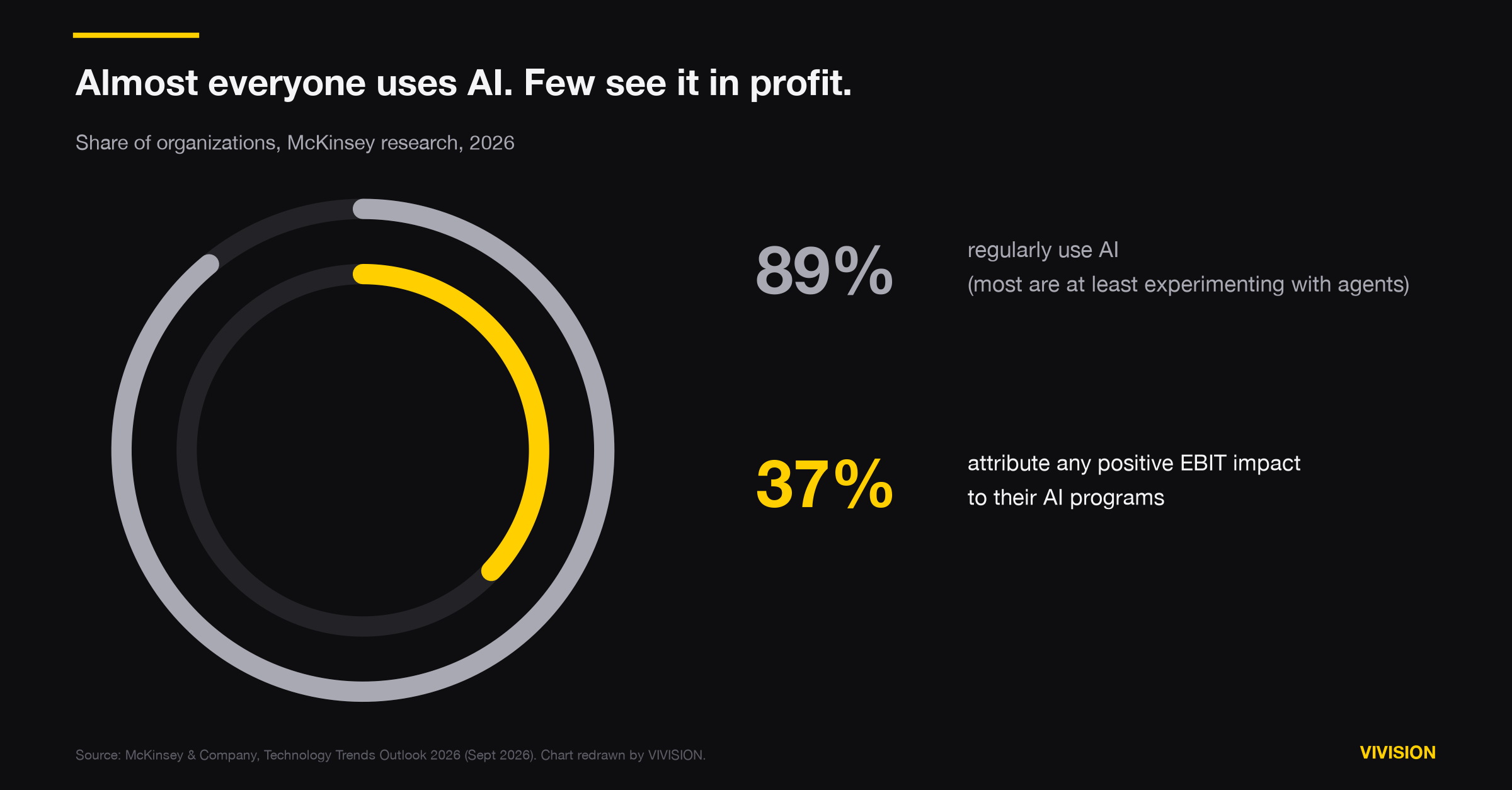
McKinsey’s research finds 89% of organizations now use AI regularly, and most are at least experimenting with agents. Yet only 37% attribute any positive EBIT impact to their AI programs at all, before you even get to the newer agent deployments. Usage is nearly universal. Profit is not.
Three things owners believe about AI agents
“If the agent is smart enough, I can let it run everything.”
Agents are getting very capable. McKinsey cites METR estimates that a leading model could succeed about half the time on software tasks that would take a skilled person roughly 12 hours (May 2026). Half the time is impressive research. It is not a reliability standard you would accept from an employee handling your customers.
“Agents are cheap. It’s just software.”
McKinsey reports that 93% of respondents to a recent McKinsey survey say they have exceeded their AI budgets. Agents run on a meter, and the meter spins faster than most people expect (more on that below).
“We’ll plug an agent into our current process and save time.”
McKinsey’s view is that the biggest gains come from redesigning workflows and operating models around people and agents working together, not from bolting agents onto the process you already have.
An agent doesn’t answer once. It thinks, checks, and tries again.
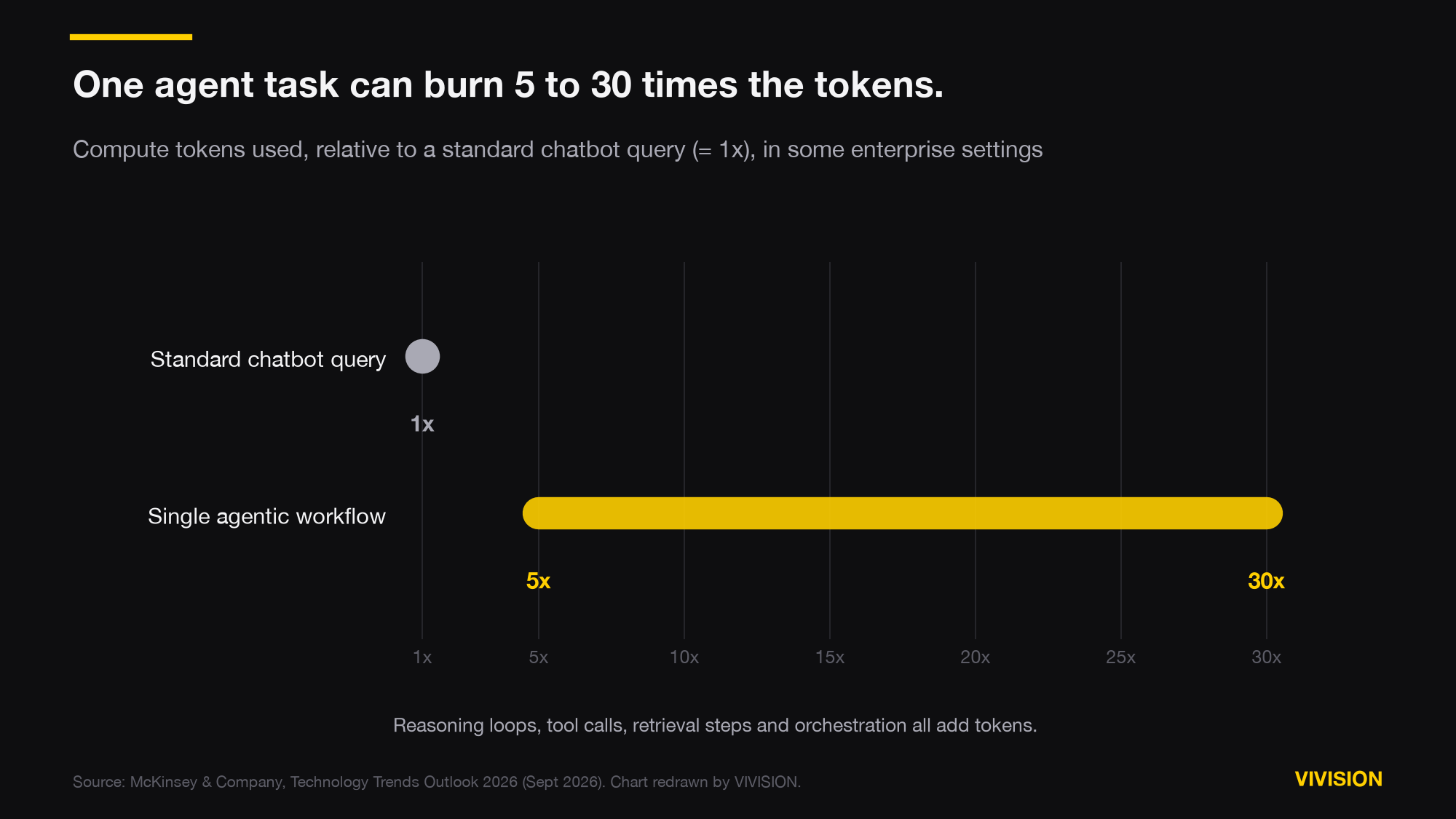
A chatbot gets a question and gives an answer. An agent loops: it reasons, calls a tool, pulls data, checks its work, and coordinates with other systems before it finishes. McKinsey’s report notes that in some enterprise environments, a single agentic workflow can use 5 to 30 times more compute tokens than a standard chatbot query. The report also points to large companies now capping internal AI use as costs climb.
Four questions to ask before an agent touches real work
This is VIVISION’s own framework, built on the risks McKinsey lists for agentic AI: reliability, accountability, security and cost. Pick one workflow. Answer each question with a plain yes or no. Tap a question to see why it matters.
Q1. If the agent gets it wrong, can you undo it in minutes?
Drafting a reply, sorting invoices or tagging leads is reversible. Sending money, deleting records or emailing a client is not. McKinsey lists reliability and trust as the first open question for agentic systems. Reversible work is where you can afford an agent’s occasional miss.
Q2. Can you check the result against a clear standard?
If “good” is written down (the invoice matches the PO, the answer cites the policy, the ticket is routed to the right team), you can test an agent before and after it goes live. The report puts weight on evaluations that are tied to business objectives. No standard means no way to know if the agent is helping.
Q3. Does it need access to only one or two systems?
Every system an agent can read or write is a new door. McKinsey notes that agents create non-human identities, such as API keys, service accounts and machine credentials, that now vastly outnumber human ones, and that integrating agents with legacy systems is an emerging bottleneck. Fewer connections means less risk and a faster start.
Q4. Do you know what one run costs, and what it saves?
Given the 5x to 30x token range above, measure the cost of a single run in a pilot, then multiply by real volume. Compare it with the time or error cost it replaces. If the math only works at the low end of the range, design for the low end or don’t scale yet.
The defining question is not how autonomous agents can become, but “how much autonomy the enterprise can safely absorb.”
Plenty of people can build an agent. Very few can make agents work together.
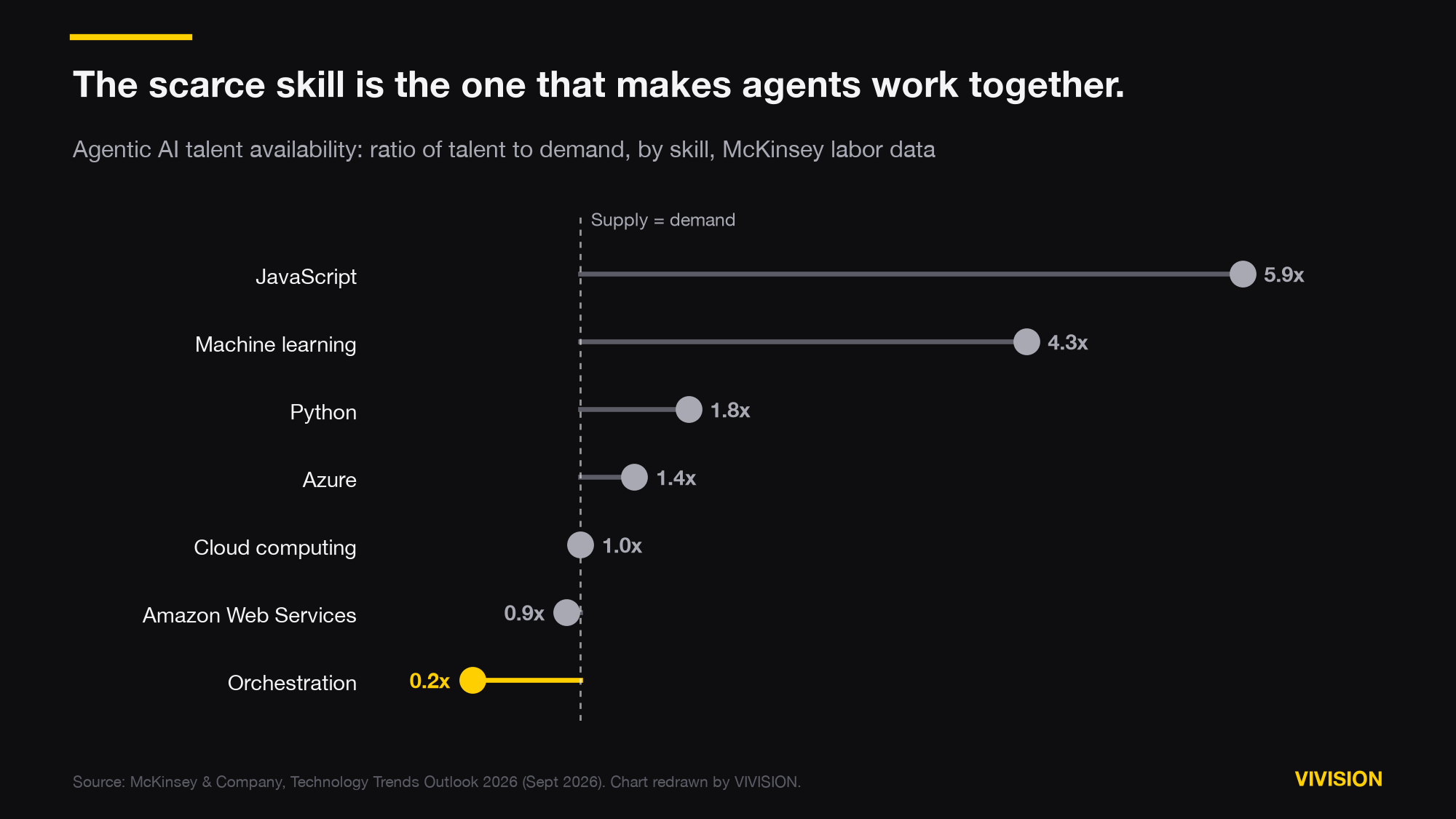
McKinsey’s labor data shows agentic AI job postings rose roughly tenfold from 2024 to 2025, off a small base. The talent pool for familiar skills is healthy: JavaScript talent outnumbers demand almost 6 to 1, and machine learning more than 4 to 1. Cloud computing, the most requested skill at roughly four in five postings, is broadly in balance. The shortage is orchestration, the layer that connects models, tools and workflows into a working system, where McKinsey’s data shows a talent-to-demand ratio of just 0.2: roughly one person with the skill for every five roles that need it.
Agents are moving inside everyday workflows
McKinsey notes Salesforce and Microsoft have both expanded tooling that lets companies configure agents across CRM, sales operations and productivity systems.
The report describes Morgan Stanley opening its stock administration platforms to AI agents from corporate clients, so those agents can pull data directly rather than through screens built for people.
McKinsey estimates agentic commerce could orchestrate as much as $5 trillion in global retail revenue by 2030, as customers state what they want and let agents compare and buy.
McKinsey rates the trend’s adoption as “piloting”: many organizations are testing, relatively few have scaled. Outside the technology sector, legacy systems, fragmented data and governance are the common brakes.
Quick answers
Is my business too small for AI agents?
No, but smaller teams should start narrower. One reversible, high-volume task with a clear standard (the test above) beats a broad “AI assistant for everything.” Small scope keeps the token bill and the risk easy to see.
Should we build our own agent or buy one?
McKinsey notes agents are raising fresh buy-versus-build questions. In our experience, most growing businesses should start with agents inside tools they already pay for, then build only where their process is truly different.
Who should be accountable when an agent makes a mistake?
A named person, always. McKinsey flags governance and accountability as an open question for the whole field. Until it is settled, the safest rule is simple: every agent has a human owner, and that owner signs off on what it is allowed to do alone.
VIVISION runs an agent readiness sprint. We list the workflows where AI could help, score each one on the 4-question test, and pick the one or two where an agent can safely act. Then we set the guardrails: the human owner, the approval step, the access it needs, and the cost per run you should expect.
You leave with a short, ranked list of where to start, where to wait, and what to fix first, instead of a pilot that quietly eats budget.
This week’s to-do
- [ ]List five repetitive tasks your team does every week.
- [ ]Run each one through the four questions. Write down the score.
- [ ]Pick the highest scorer and name its human owner.
- [ ]Write down what “done right” looks like, so you can check the agent’s work.
- [ ]Set a monthly spend cap for the pilot before it starts.
Not sure which work to hand to an agent first?
Send us your list of five tasks. We will tell you which one we would start with, and why.
Source: McKinsey & Company, “Technology Trends Outlook 2026” (Sixth edition, September 2026), Agentic AI chapter. All statistics are McKinsey’s, including McKinsey survey and labor-market data and third-party data the report cites (such as METR time-horizon estimates). Charts were redrawn by VIVISION from the published figures. The “VIVISION insight” sections, the 4-question test and scorecard, the quick answers, and “what we do for clients” are VIVISION’s own views and are not McKinsey’s.
Copyright in the original report belongs to McKinsey & Company. Cover photo: Unsplash.