
Navigating the complexities of business expansion can be both exhilarating and challenging. This article introduces the SPOE Matrix, a strategic toolkit designed to help business owners identify their current state and determine effective actions for growth. By incorporating insights we provide a data-driven approach to guide businesses through their expansion journey.
Business expansion is a critical phase for any company seeking sustainable growth. However, the path to expansion is not one-size-fits-all. Understanding where a business stands in terms of market potential and internal readiness is crucial for devising effective strategies. To aid business owners in this process, we introduce the SPOE Matrix, which categorizes businesses into four distinct quadrants: Stabilize, Prepare, Optimize, and Expand. Each quadrant offers tailored actions to address specific challenges and opportunities.
The SPOE Matrix
The matrix is built on two key dimensions: Market Growth Potential and Internal Readiness for Expansion. These dimensions intersect to form four quadrants, each representing a unique state of business expansion.
Internal Readiness and Market Growth Potential
Before diving into the matrix, it is essential to understand the two key dimensions that define the quadrants:
Internal Readiness refers to a company’s ability to support and sustain growth from within. This includes factors such as operational efficiency, financial health, infrastructure, and workforce capabilities.
Market Growth Potential refers to the opportunities available in the external market for the business to expand. This includes factors such as market demand, competitive landscape, and industry growth trends.
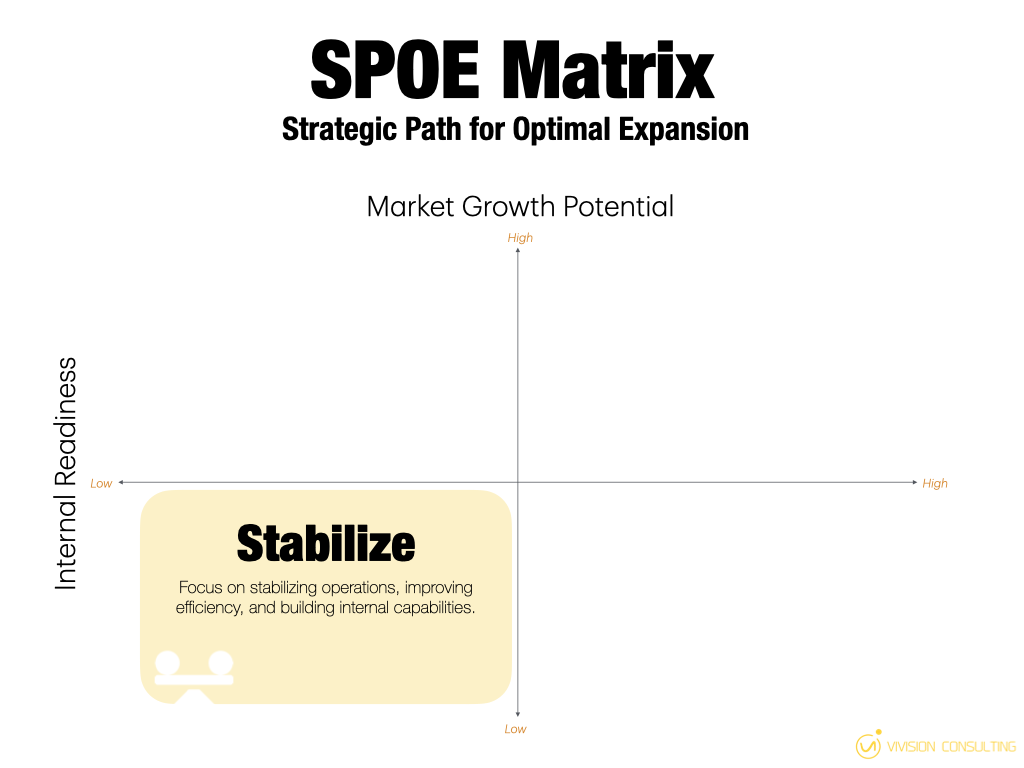
Stabilize
Low Internal Readiness, Low Market Growth Potential
Scenario: Businesses in this quadrant face limited market opportunities and lack internal capabilities to expand.
Actions: Focus on stabilizing operations, improving efficiency, and building internal capabilities.
Research by McKinsey shows that companies focusing on operational excellence and strategic planning are 30% more likely to achieve sustained growth.
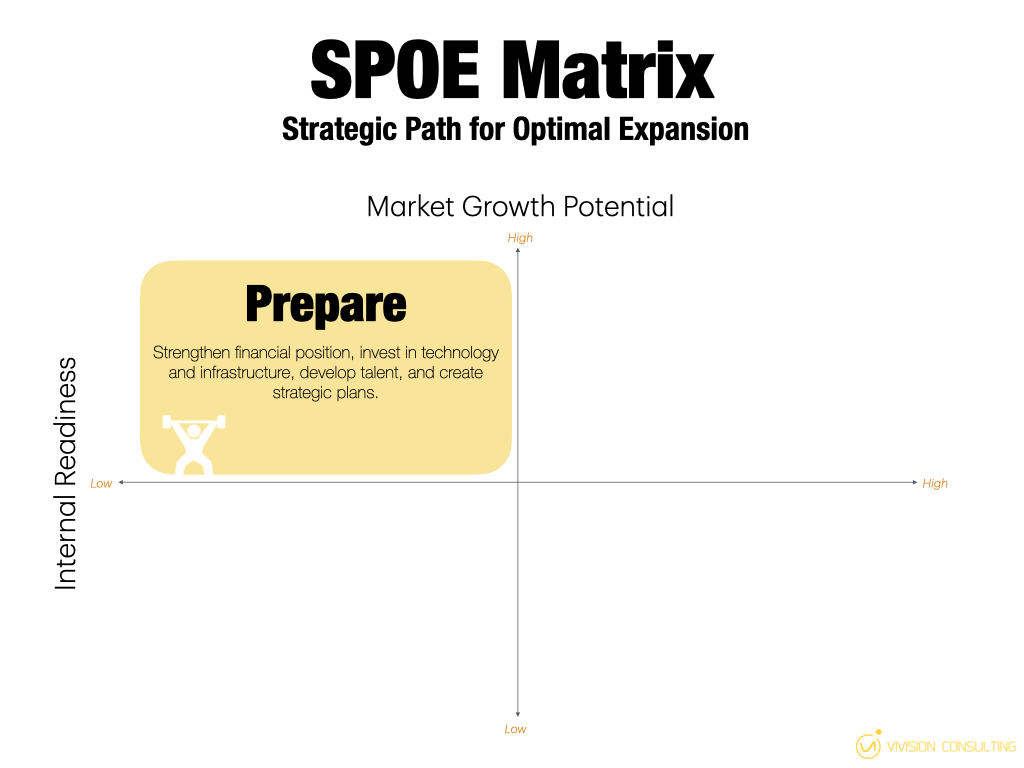
Prepare
Low Internal Readiness, High Market Growth Potential
Scenario: These businesses have significant market opportunities but are not yet ready internally to capitalize on them.
Actions: Strengthen financial position, invest in technology and infrastructure, develop talent, and create strategic plans.
According to Deloitte, businesses investing in digital transformation see a 23% increase in operational efficiency.

Optimize
High Internal Readiness, Low Market Growth Potential
Scenario: Businesses here have strong internal capabilities but face limited market opportunities.
Actions: Optimize current operations and leverage existing strengths to maximize profitability.
Harvard Business Review emphasizes that companies adept at shifting strategies in response to market changes are 50% more successful in achieving their growth targets.
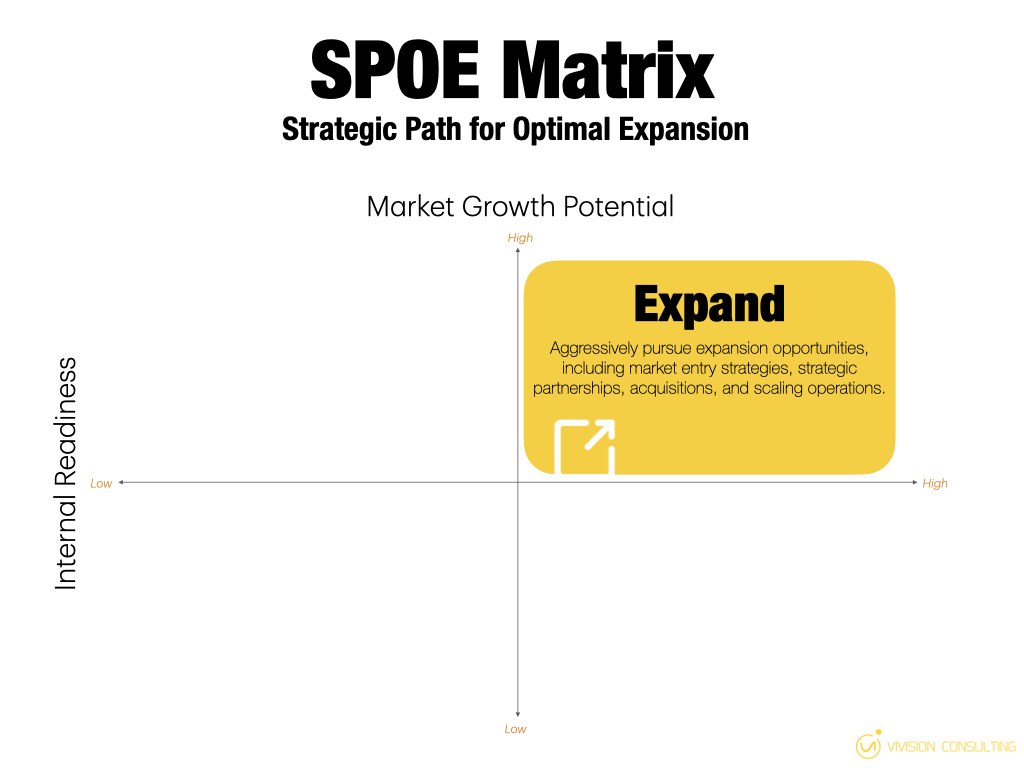
Expand
High Internal Readiness, High Market Growth Potential
Scenario: These businesses are well-positioned internally and operate in markets with high growth potential.
Actions: Aggressively pursue expansion opportunities, including market entry strategies, strategic partnerships, acquisitions, and scaling operations.
Conclusion
The path to business expansion is multifaceted and requires a strategic approach tailored to the specific context of the business. By utilizing the SPOE Matrix, business owners can gain clarity on their current position and take informed actions to move towards growth.
Leveraging insights from industry leaders ensures that these strategies are grounded in proven methodologies and data-driven insights. As businesses navigate their expansion journeys, the matrix serves as a valuable tool to guide decision-making and drive sustainable growth.
