
McKinsey says technology has moved off the screen and into grids, equipment and physical sites. Here is how to plan around power, lead times and hands-on people so your launch dates hold.
For most of the last decade, a technology plan was a software plan. You picked a tool, paid the subscription and switched it on. McKinsey’s Technology Trends Outlook 2026 opens with a clear signal that this is changing: the technology story of 2026 has left the screen and moved into power grids, chips, robots and physical sites.
That shift changes what slows a business down. The limit is less often “can the technology do it?” and more often “can we get the power, the equipment and the hands-on people in time?” Those three limits run on lead times measured in months and years, not days. The good news: a limit you can see coming is a limit you can plan around. This article shows how.
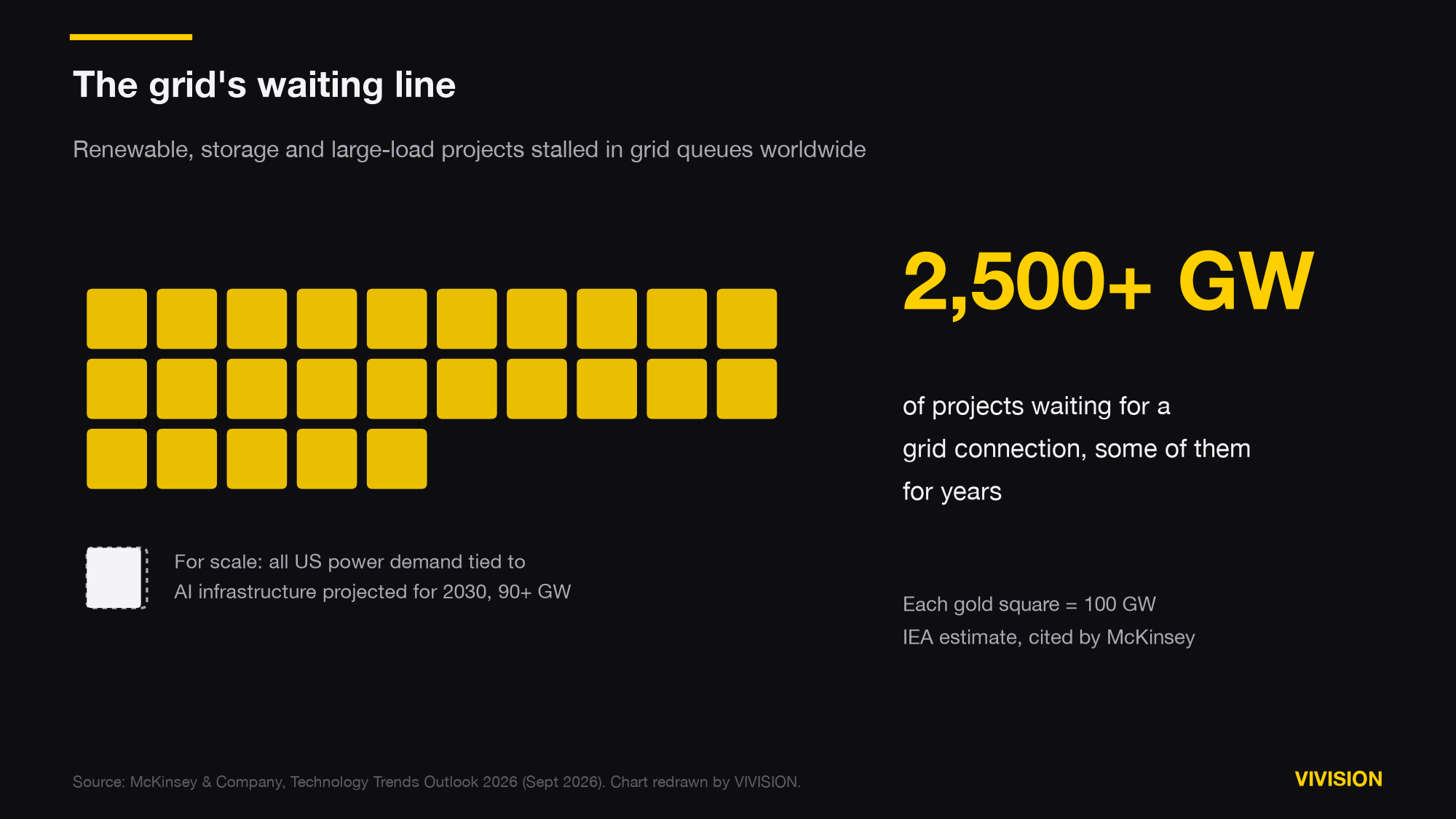
Figures: McKinsey & Company, Technology Trends Outlook 2026, introduction and energy chapter. The report puts 2025 energy investment at $194.2 billion. The grid queue figure is an IEA estimate the report cites.
McKinsey’s energy chapter describes exactly this change for utilities and large power users. VIVISION’s view is that the same question now applies to equipment and skilled people too.
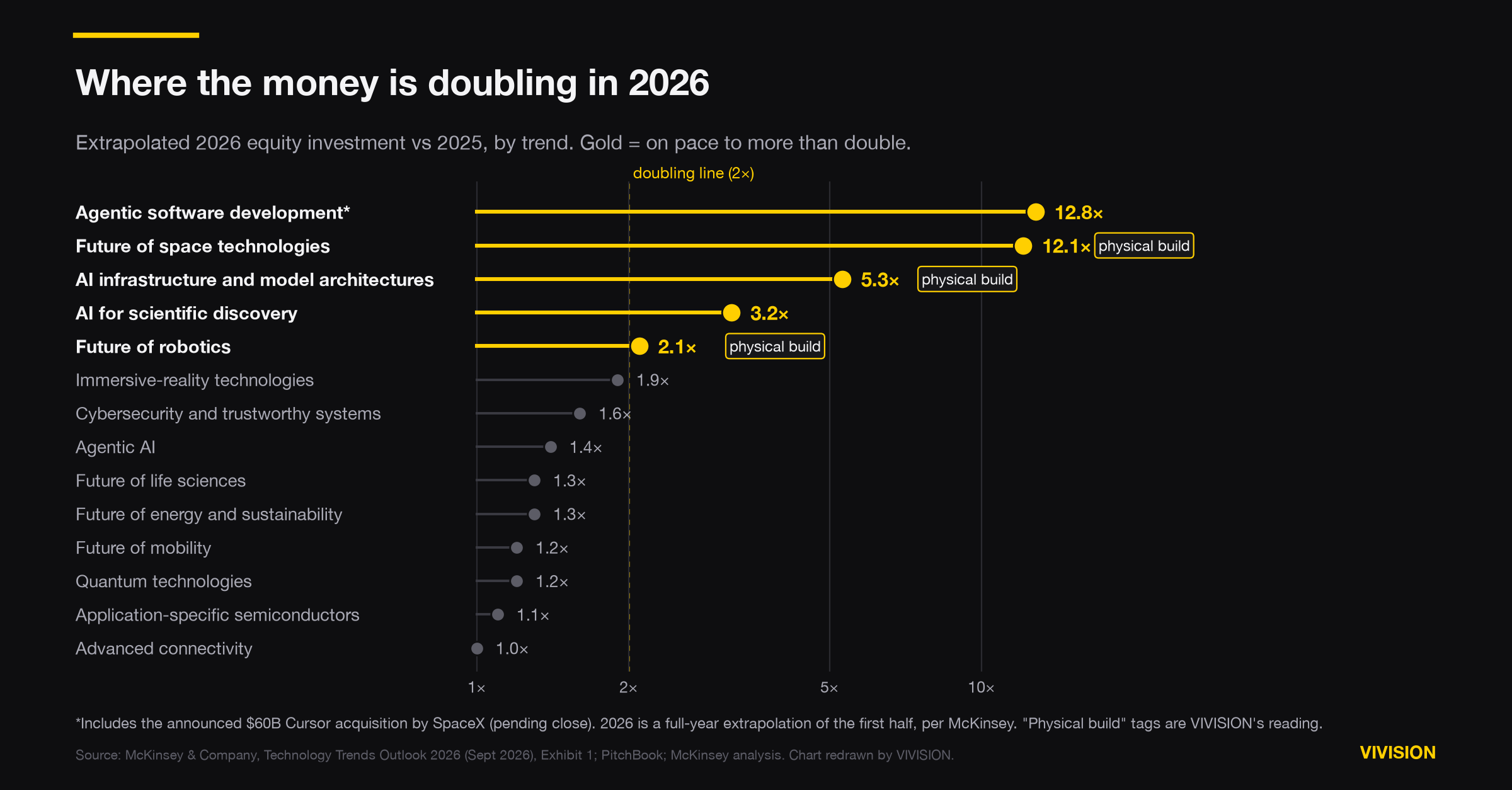
McKinsey reports that five of its 14 trends are on pace to receive more than double their 2025 investment in 2026, and that every trend except advanced connectivity is heading for a higher funding total. Look at what three of those five actually build: rockets and satellites, data centers, and robots. In VIVISION’s reading, a large share of the fresh money is flowing into things you can touch, and physical things come with physical waiting times.
AI is hungry, and the grid is not ready
The report is blunt that power has become the constraint clever engineering cannot fully solve. It projects that US data centers running AI workloads alone could use as much electricity by 2030 as California does today. The harder problem, McKinsey says, is delivery: data centers can go up faster than the transmission lines, substations and transformers needed to feed them.
Big energy users are already adapting. McKinsey describes large users moving from simply buying power to actively orchestrating it: long-term contracts, dedicated infrastructure and on-site generation, all aimed at cutting their exposure to connection delays.
The parts list now has a calendar attached
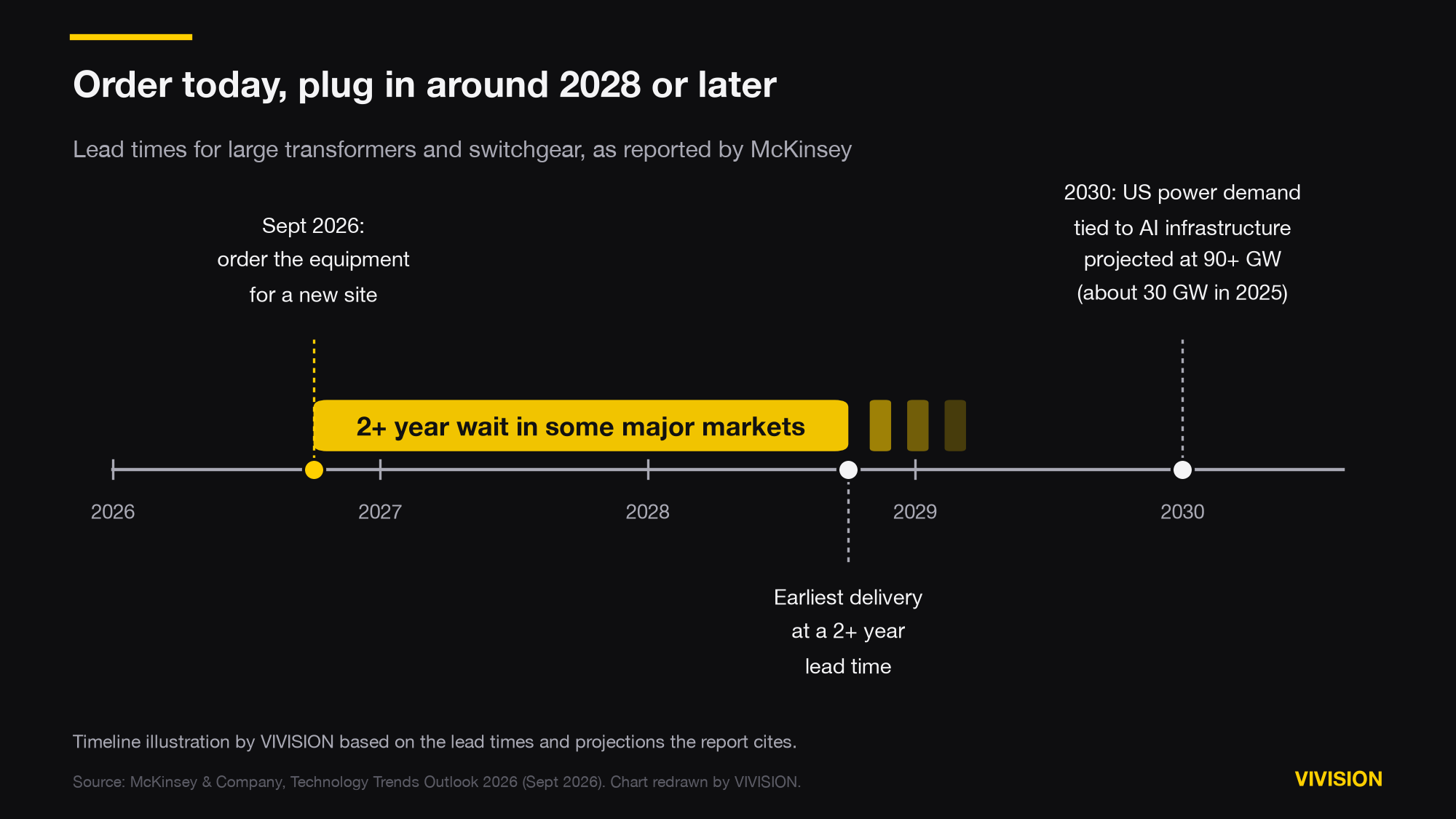
McKinsey notes that transformers in many markets now carry lead times of more than two years, and that even hyperscalers wait months for the materials to build new data centers. This is not only a tech-industry problem. In the mobility chapter, the report says lead times for the large transformers and switchgear needed at high-power charging depots have passed two years in some major markets, turning big charging projects into multiyear efforts.
The report also shows what smart operators do about it. Where public charging is still a bottleneck, some vehicle makers are shifting toward freight trucks, whose routes are predictable and whose depot charging can be planned ahead. McKinsey reports that electric heavy-freight truck sales tripled in 2025 to more than 200,000 units worldwide. The lesson travels well: pick the version of the project whose constraints you can plan.
Physical AI needs people who can make it work on site
McKinsey calls physical AI the next frontier and says it is arriving first in manufacturing and logistics, where the economics are clearest. It also says most manufacturers will get value by adding robots to the plants they already have, rather than building showcase “dark factories”. And in robotics, the report finds that coding and machine learning skills are plentiful; the harder constraint is finding people who can connect AI with hardware, controls and deployment.
A 4-line readiness check
A VIVISION tool covering the three limits, with compute split out from power. Score each row 0, 1 or 2 for your next major technology project.
| Line | 0 points | 1 point | 2 points |
|---|---|---|---|
| Power | Not checked | We know our load, but not what the site or utility can supply | Capacity confirmed in writing, with a date |
| Equipment | Launch date set before any quotes | Quotes in hand, lead times unknown | Every long-lead item listed, ordered or reserved |
| Compute | “The cloud will scale” | Usage estimated, no commitment | Capacity and pricing agreed for year one |
| People | Vendor will handle it | Internal owner named, no time freed up | Site owner and integration help both booked |
Quick answers
We only use cloud software. Does any of this affect us?
Indirectly, yes. McKinsey says that for enterprises, securing reliable compute is becoming a competitive advantage on par with talent and capital. VIVISION’s view: if AI is becoming core to how you serve customers, treat capacity and pricing with your providers as a planning item, not an afterthought.
Should we generate our own power?
The report notes that large users are exploring on-site options to reduce exposure to grid delays, and stresses these are early proof points, not a broadly scaled solution. For most growing businesses, VIVISION would start with the cheaper steps: confirm capacity early, use energy more efficiently, and schedule heavy loads smartly.
Is it too early to plan for robots or physical AI?
McKinsey says near-term value is clearest in repetitive, structured work such as materials handling, inspection and lab automation, mostly in existing facilities. If you run that kind of operation, the planning should start now, precisely because the physical lead times are long.
How solid are these numbers?
The investment multiples are McKinsey’s extrapolation of first-half 2026 deals, which the report itself calls directional. The lead-time and grid figures come from sources the report cites, including the IEA. Use them as signals of direction and scale, then check your own site and suppliers.
VIVISION runs a capacity-first technology plan. We take your roadmap, map every project against the three real-world limits, power, equipment and hands-on people, and rebuild the timeline around the longest lead times. Where a limit cannot move, we help you pick the version of the project that can.
You leave with launch dates you can defend to your board and your bank, and fewer surprises in month nine.
Planning a project that needs more than software?
Send us the plan. We will show you which limit will set your real launch date.
Source: McKinsey & Company, “Technology Trends Outlook 2026” (Sixth edition, September 2026), introduction, Exhibit 1, and the AI infrastructure, robotics, mobility and energy chapters. All statistics are McKinsey’s, including sources the report cites such as the IEA and PitchBook. Charts were redrawn by VIVISION from the published figures. The “physical build” labels, the scale comparison, the timeline illustration, the “VIVISION insight” sections, the readiness check, the Monday checklist, the quick-answer opinions and “what we do for clients” are VIVISION’s own views and are not McKinsey’s.
Copyright in the original report belongs to McKinsey & Company. Cover photo: Amirreza Taqavi on Unsplash.