
Pursuing entrepreneurial opportunities across borders can unlock significant growth potential, but it also presents a unique set of challenges. One of the biggest hurdles business owners face when immigrating their ventures is the high level of ambiguity surrounding new markets, regulatory landscapes, and operational environments. This ambiguity can breed uncertainty, increase risks, and impede effective decision-making.
According to a study by the Lauder Institute at the University of Pennsylvania, over 60% of businesses that attempt cross-border expansion fail due to a lack of understanding of the local market and business environment.[1]
The same study found that companies that invested in thorough market research and cultural awareness were nearly twice as likely to succeed in their international expansion efforts.
Sources of Ambiguity in Global Expansion
The ambiguity stems from a multitude of factors, including:
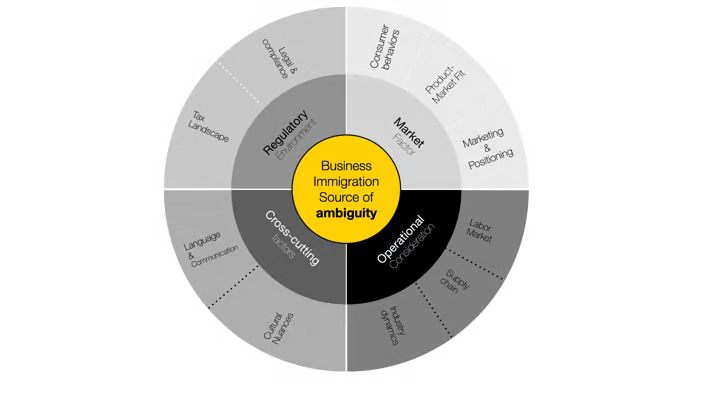
Data from the U.S. Bureau of Labor Statistics highlights the stark reality: approximately
20% of new businesses fail during their first year,
50% within five years, and
66% within ten years. [2]
While these statistics encompass businesses operating domestically, the risks and challenges are amplified when expanding across borders due to the added layer of ambiguity.
Approaches to Finding Clarity Amidst Ambiguity
To navigate this ambiguity successfully, business owners must adopt strategic approaches to gather reliable information, leverage relevant expertise, and build a deep understanding of the new market and operational environment. This not only minimizes risks but also unlocks opportunities for competitive differentiation and long-term growth.
1. Firsthand Experience
This involves the business owner directly going through the process of establishing their venture in the new country, learning through trial and error.
Pros: Highly reliable and customized knowledge gained.
Cons: Most time-consuming and costly method, especially if mistakes occur during the learning curve.
2. Structured External Experience
This approach involves seeking guidance from structured resources like consulting firms or professional training programs that specialize in helping businesses immigrate.
Pros: Reliable, vetted information from subject matter experts. Faster learning curve.
Cons: Generally more expensive than other methods.
3. Unstructured External Experience
This involves tapping into unstructured sources like networking events, informal conversations with experienced entrepreneurs, or relevant industry meetups.
Pros: Potentially faster insights and lower cost.
Cons: Reliability varies; finding relevant and accurate sources can be time-consuming.
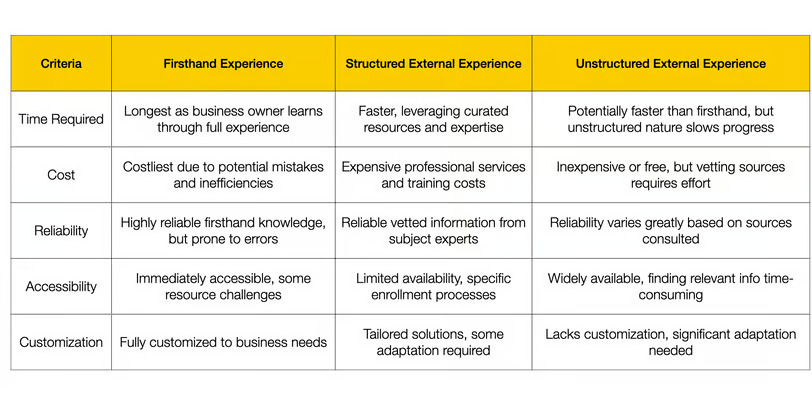
Unstructured sources can provide potentially faster insights compared to firsthand learning and are generally inexpensive or free. However, the reliability of information may vary, and finding truly relevant sources can be time-consuming.
The table below summarizes the key trade-offs between these three approaches across different criteria:
Conclusion: Blending Strategies for Clarity and Growth
Ultimately, the ideal strategy may involve combining these approaches. An entrepreneur could start by gathering initial insights through unstructured networking, then engage professional consulting services for comprehensive guidance while continuing to build vital firsthand experience.
No matter which path is chosen, proactively addressing the ambiguity of establishing a new business in a new country is crucial. With the right approaches and mindset, entrepreneurs can transform ambiguity from a barrier into an opportunity to gain invaluable knowledge and a competitive edge.
Sources:
[1] Lauder Institute’s Program on the Study of International Business Expansion
[2] U.S. Bureau of Labor Statistics, Business Employment Dynamics
