
McKinsey finds productivity fell in 30% of companies after adopting agentic AI tools. VIVISION breaks down why, and lays out the four-stage road map that separates the top performers.
McKinsey’s Technology Trends Outlook 2026 says most organizations are racing to deploy AI at scale without any proven road map. They have workforces that need upskilling, legacy systems that need updating, and shortages in talent and capital.
The result shows up in the numbers: some companies pull well ahead, some fall behind, and the difference is rarely the tool itself.
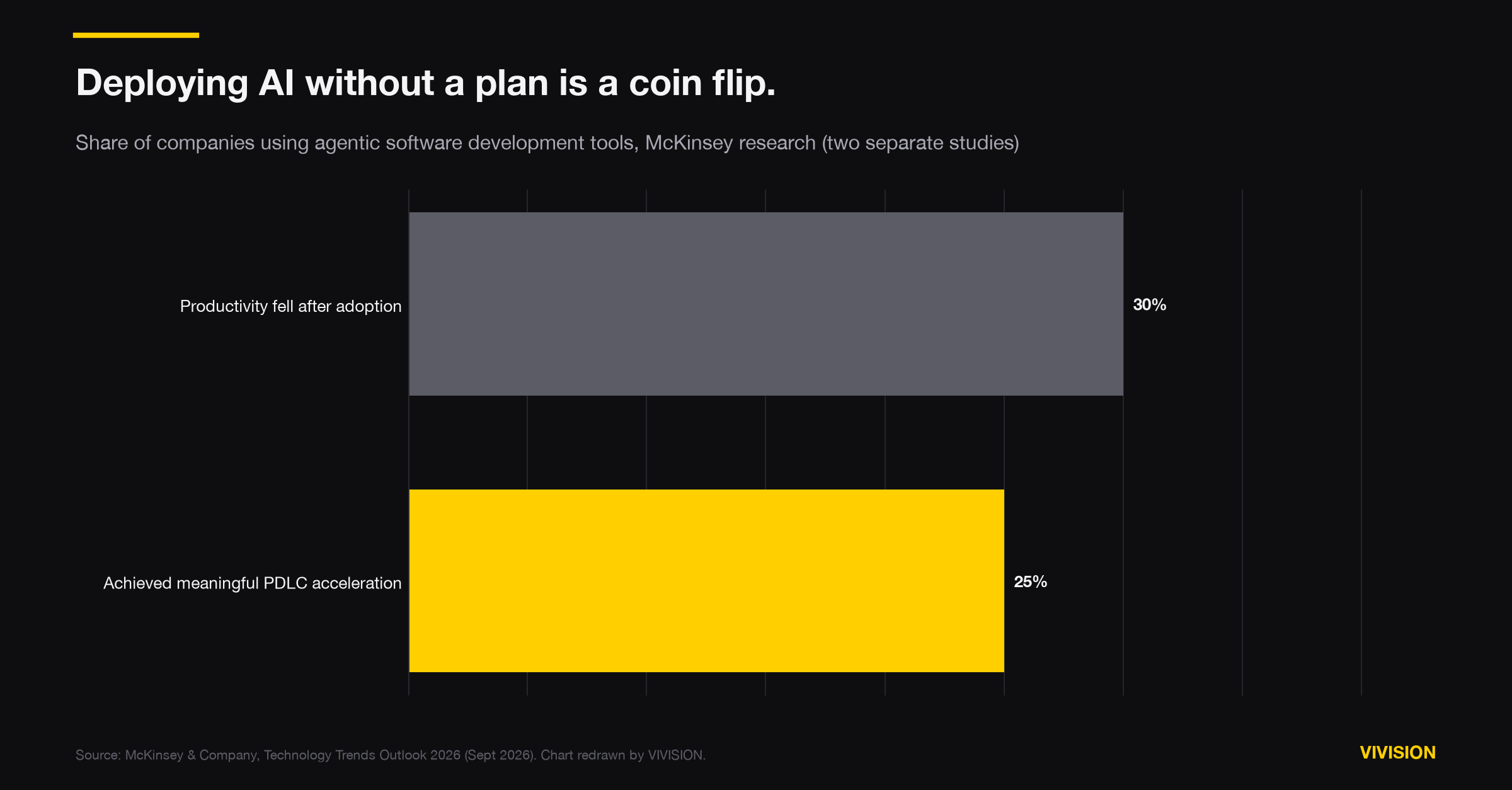
Without a plan, the odds are worse than you would think.
McKinsey’s research on agentic software development found that just one in four companies using these tools achieved what it calls meaningful acceleration: more than a quarter of their teams reaching twofold or greater productivity gains. In a separate study cited in the same chapter, productivity fell in 30% of companies after teams began using agentic AI tools. Almost everyone is generating more code. Far fewer are shipping more product.
Half your team may not believe the tool they are using.
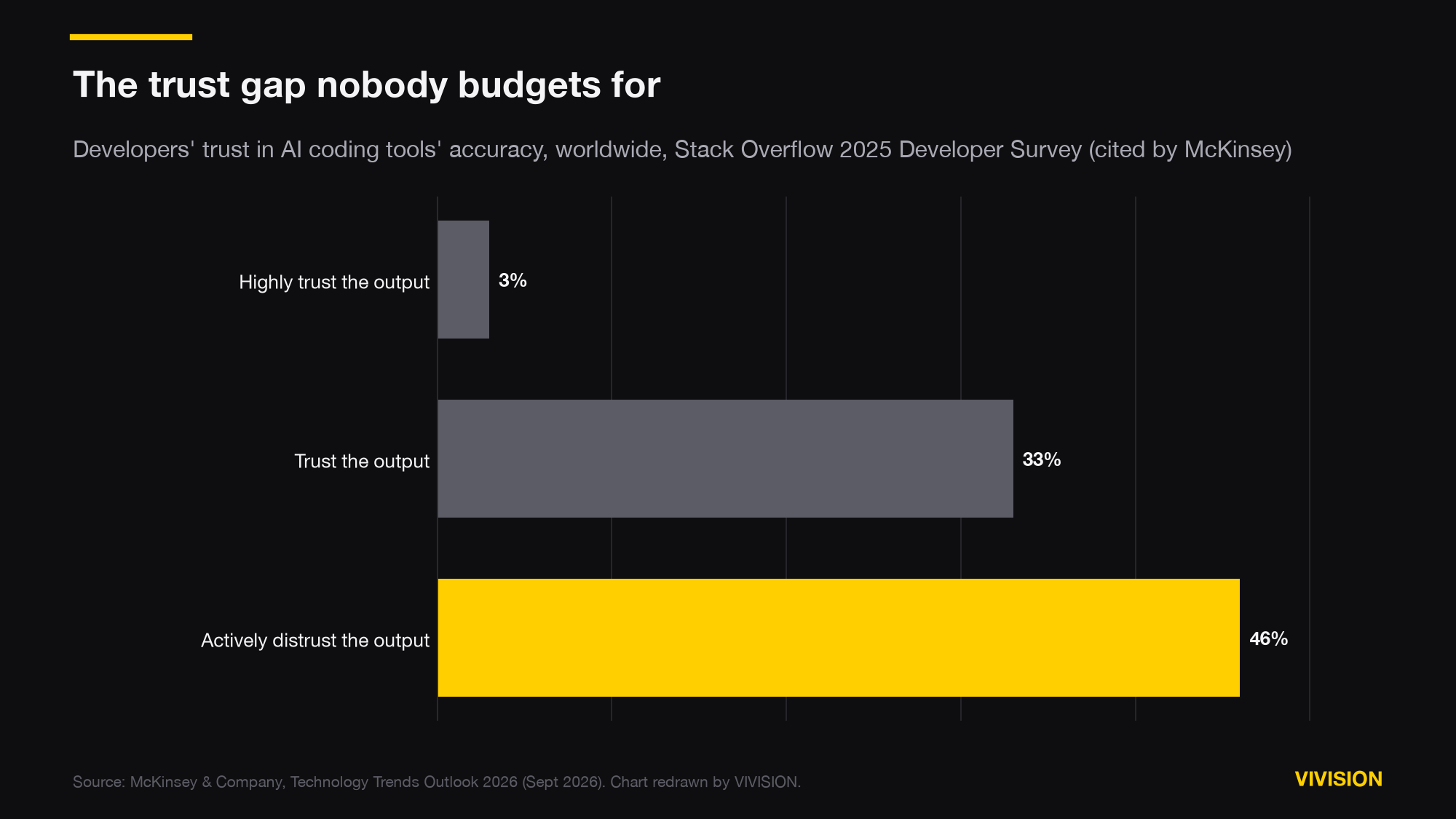
McKinsey cites survey data showing 46% of developers worldwide actively distrust the accuracy of AI coding tools, compared with 33% who trust them, and only 3% who highly trust the output. That trust gap sits on top of a technical one: McKinsey calls agent integration with legacy systems an emerging bottleneck, as companies discover that connecting agents to old APIs and ERP systems is harder than generating the code itself. Where a structured approach is used, McKinsey finds AI agents can speed up legacy modernization work by 40 to 50%, and cut its cost by up to 40%.
The average user and the best user are not using the same tool differently. They are working differently.
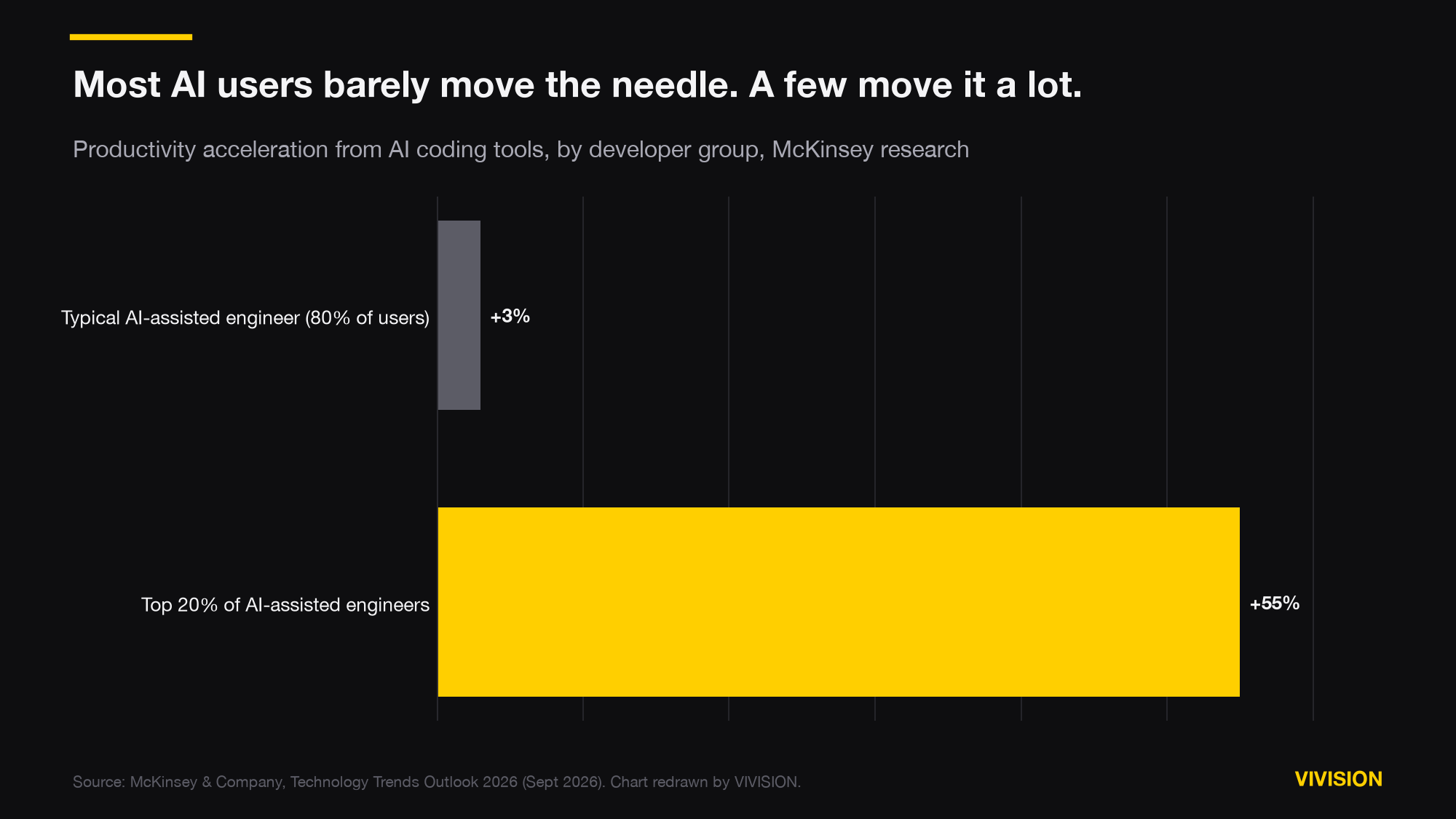
McKinsey finds that 80% of software engineers using AI tools see a productivity acceleration of around 3%. The top 20% see a 55% boost. AI now accounts for roughly a third of what companies spend to introduce new capabilities, so that gap is no longer a curiosity. It is a budget line with a wide spread of return. McKinsey’s own advice: the organizations capturing the value are the ones supporting developers with change management, embedding the tools into workflows, and verifying agentic output against clear quality standards, not the ones who simply hand out licenses.
Four stages, in order. Skipping one is why most companies stall.
This sequence is VIVISION’s method, built to move a team through McKinsey’s own adoption stages without the false starts.
A useful tell for where you really are: McKinsey’s own talent data shows that in the AI-focused trends, over 75% of job postings are still for R&D roles, teams still building the thing. In trends already being deployed commercially, like connectivity and cybersecurity, more than half of postings are operations, sales, or administrative roles. If your hiring still looks like the first group, you are earlier in the road map than your budget suggests.
Where does your organization actually sit?
McKinsey scores technology adoption on a five-stage ladder. Here is what each stage means for your next move.
Stage 1, frontier innovation: nobody here is using it yet
Watch and read. Do not build a business case on a technology that is still unproven.
Stage 2, experimentation: small prototypes, no ROI pressure yet
Keep it small on purpose. Use this stage to find where trust and legacy integration will actually break, before real budget is attached.
Stage 3, piloting: first live use cases, testing feasibility
This is where most companies we see actually are, whether they admit it or not. Name the one metric now, before the pilot quietly becomes “how we do things.”
Stage 4, scaling in progress: rolling out across the enterprise
This is where the trust gap and the performer gap get expensive if they were never addressed. Fix the workflow before you fix the headcount.
Stage 5, fully scaled: it is now just how the business runs
Very few AI use cases are here yet, McKinsey included this stage for a reason. If you think you have arrived, check whether the metric from stage 2 is still being tracked.
Your Monday checklist
- Name your stage, honestly. Use McKinsey’s five-stage ladder above, not what the slide deck says.
- Find the trust gap. Ask the team who actually checks AI output before it ships, and how.
- List what touches legacy systems. Those are the last workflows to automate, not the first.
- Write down the one metric. If your current AI pilot does not have one, it is not a pilot yet.
Not sure which stage you are actually on?
Tell us what you have deployed so far. We will help you build the road map for what comes next.
Source: McKinsey & Company, “Technology Trends Outlook 2026” (Sixth edition, September 2026). All statistics are McKinsey’s, including data it cites from the Stack Overflow 2025 Developer Survey. Charts were redrawn by VIVISION from the published figures. The “VIVISION insight” sections and the four-stage road map in chapter 04 are VIVISION’s own analysis and are not McKinsey’s views.
Copyright in the original report belongs to McKinsey & Company.