
McKinsey's talent data shows AI model builders are plentiful while the people who get AI into daily operations are scarce. Here is how to build, borrow or buy the missing skills.
When an AI project stalls, most owners reach the same conclusion: we need an AI expert. So they post a job for a data scientist or a machine learning engineer, wait months, and the project still sits in pilot. McKinsey’s newest talent data suggests they were shopping for the wrong skill.
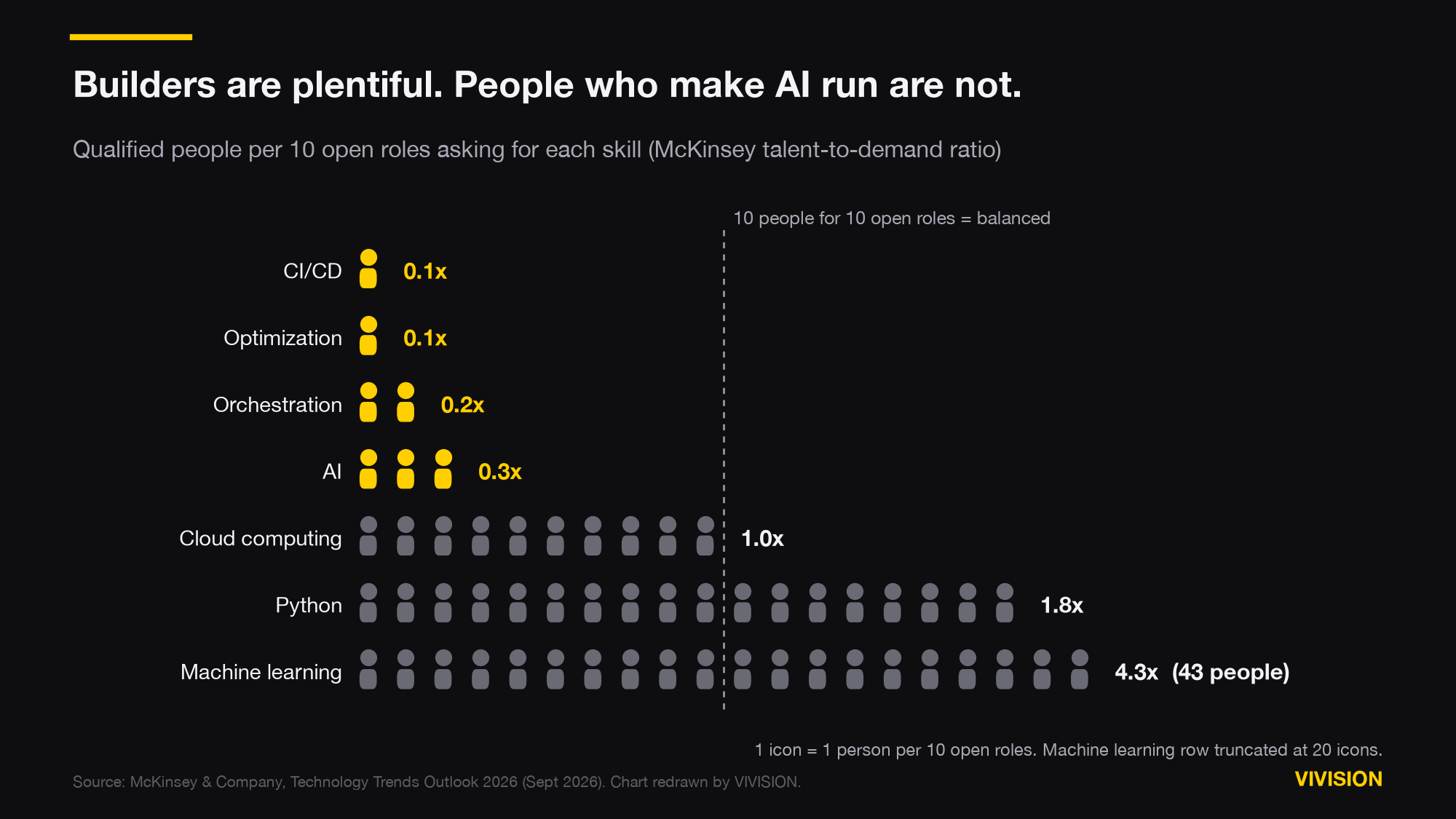
The Technology Trends Outlook 2026 tracks job postings and skill supply across 14 technology trends. Read side by side, the chapters tell a consistent story. The people who can build AI models are, by the report’s numbers, relatively easy to find. The people who can put AI into daily operations, connect it to your systems and keep it running are not. That second group is the real bottleneck, and it is the one most growing businesses forget to plan for.
Figures: McKinsey & Company, Technology Trends Outlook 2026, talent and labor market pages for each trend. “~1 in 10” is VIVISION’s plain reading of the talent-to-demand ratio of 0.1 the report shows for these skills.
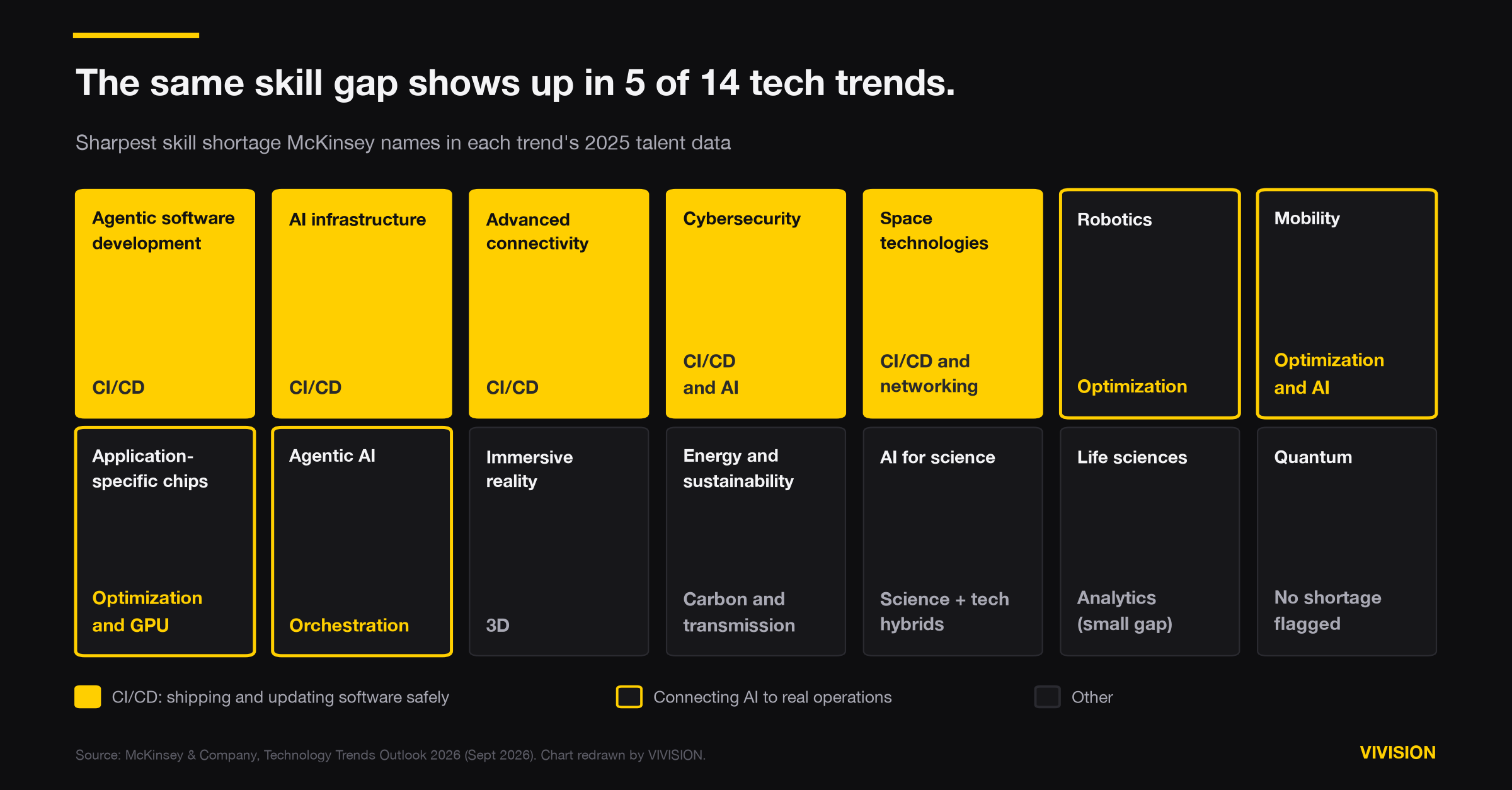
Each chapter of the report closes with a talent section that names the skills where qualified people fall shortest of demand. The same answer keeps coming back. In agentic software development, AI infrastructure, advanced connectivity, cybersecurity and space technologies, the sharpest gap McKinsey points to includes continuous integration and continuous delivery, usually shortened to CI/CD. In plain terms, that is the discipline of testing, releasing and updating software safely and often. In robotics, mobility and custom chips, the gap is optimization. In agentic AI, it is orchestration, the layer that makes models, tools and workflows work together.
Everyone is chasing the same small pool
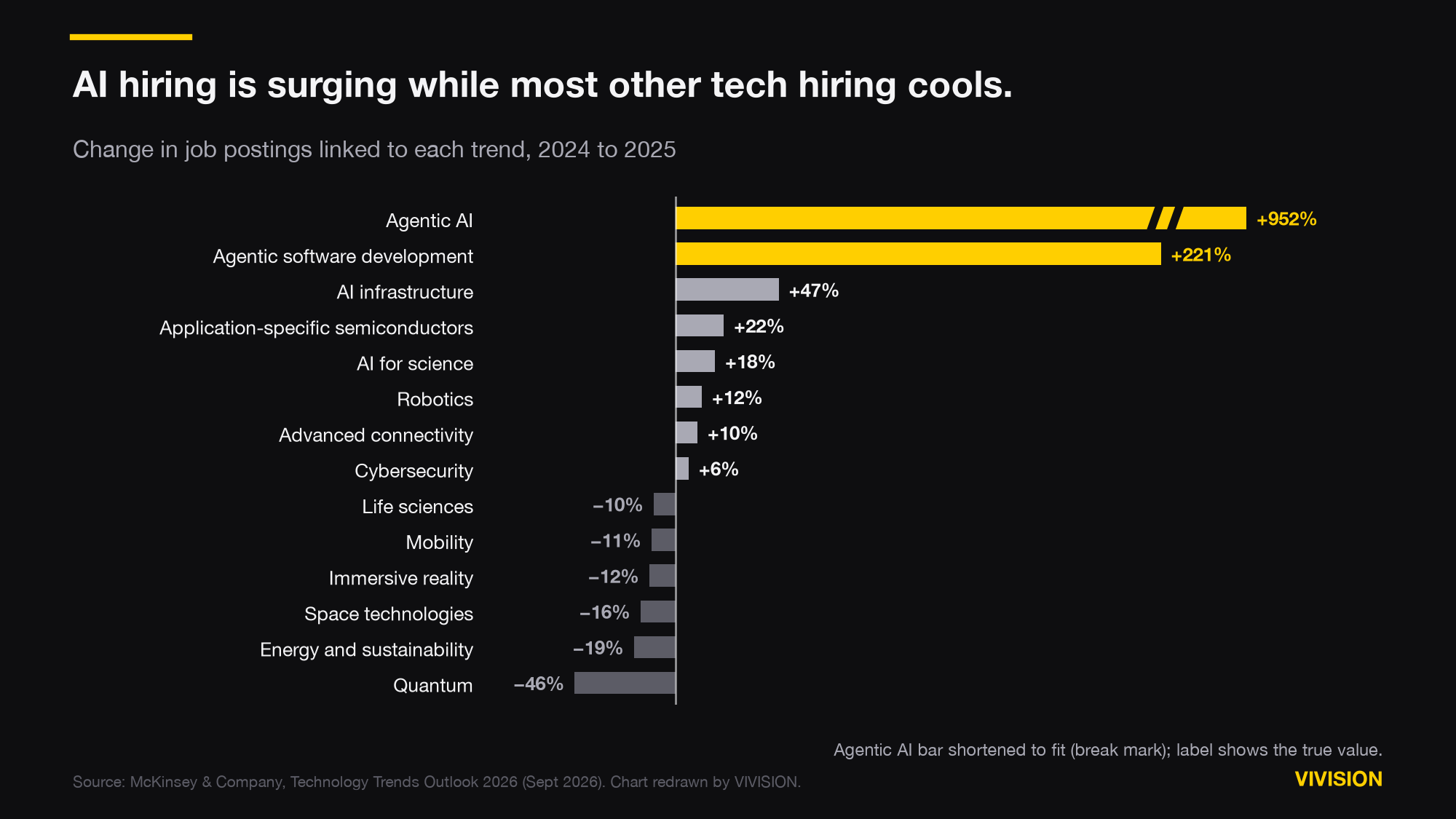
McKinsey reports that agentic AI postings rose roughly tenfold from 2024 to 2025, and agentic software development postings more than tripled. At the other end, quantum, energy, space and mobility all posted fewer roles. In energy and sustainability, the report notes that most core build-out roles, such as technicians, electrical engineers and project managers, are down roughly 40 percent or more since 2022.
The report’s introduction is direct about what this means for companies: organizations face shortages in energy, talent and capital, and have workforces that need upskilling. The AI infrastructure chapter lists skilled labor next to processors and power equipment as an emerging bottleneck to scaling.
What the talent data actually says
“Our AI project is stuck because we can’t find a data scientist.”
Machine learning and Python skills are well supplied across most trends, McKinsey’s data shows. The gaps sit in getting AI into production: CI/CD, orchestration and optimization.
“AI means we will simply need fewer people.”
The report describes a shift to smaller, highly leveraged teams focused on defining the product, designing the system and handling exceptions, and says this requires significant upskilling. Fewer seats, different skills.
“The skills gap is a problem for tech companies, not us.”
The same pattern appears in telecom, space, mobility and robotics. In robotics, McKinsey says the harder constraint is finding people who can connect AI with hardware, controls and deployment. That is an operations skill.
Builders are plentiful. People who make AI run are not.
What each scarce skill means for a business that is not a tech company. The translations are VIVISION’s.
| Skill in the report | What it means in your business | Sign you are missing it |
|---|---|---|
| CI/CD | Moving a tool from “works in the test” to “used every day”, and updating it without breaking things. | Pilots that impressed everyone but never went live. |
| Orchestration | Connecting AI tools to each other and to your CRM, finance and operations systems so work flows end to end. | Staff copy and paste between the AI tool and everything else. |
| Optimization | Tuning a system for real conditions: cost, speed, accuracy, the messy cases. | It works in the demo and fails on Monday morning volume. |
| AI (applied) | Knowing which AI approach fits which business problem, and when not to use it. | Tools chosen by vendor pitch rather than by problem. |
Match each skill to the right way of getting it
A VIVISION decision guide, built on the supply picture in McKinsey’s talent data.
For: workflow ownership, applied AI judgment, day-to-day tool use.
Pick one respected operator per AI use case and give them time and training. This knowledge is specific to your business and compounds.
For: CI/CD, orchestration, optimization.
These are the scarcest skills in the data. Use a partner to set up the release and integration plumbing once, and to hand over a simple way to run it.
For: model building, standard AI features.
Model skills are well supplied, and vendors are building agents into the software you already pay for. Buy capability before you hire to create it.
From stuck pilot to running process
Quick answers
We are not a software company. Why should CI/CD matter to us?
Because every AI tool you adopt is software that needs to be released, updated and checked. McKinsey’s space chapter describes a workforce better equipped for traditional engineering than for the automation and continuous-update work the sector now needs. VIVISION’s view: the same is true of most traditional businesses adopting AI.
Should we stop hiring engineers, like some large firms?
The report notes that Salesforce said it would not hire more software engineers in 2025 after productivity gains from AI-assisted development. VIVISION’s view: that is a signal about team shape, not a rule for you. Most growing firms need fewer generalist hires and more deliberate ownership of how AI runs.
Is upskilling our current team realistic?
For ownership and applied AI judgment, yes, and it is usually faster than hiring. For the rarest technical skills, pair training with outside help until the process is stable. McKinsey’s talent data shows those skills are scarce for everyone.
How reliable are these talent numbers?
McKinsey measures job postings through its Organizational Data Platform, drawn mainly from English-speaking countries. Treat the figures as strong directional signals about where supply and demand diverge, not as a hiring forecast for your city.
VIVISION runs an AI capability review. We look at your AI pilots, find where each one breaks between demo and daily use, and sort every missing skill into build, borrow or buy. Then we design the team shape: who owns each process, what your people learn, and what stays with a partner.
The result is a plan that gets your first pilot running in weeks without joining the hiring race for the scarcest engineers.
Have an AI pilot that never went live?
Tell us where it stopped. We will tell you which skill is missing and the fastest way to get it.
Source: McKinsey & Company, “Technology Trends Outlook 2026” (Sixth edition, September 2026), introduction and the talent and labor market pages of all 14 trend chapters. All statistics are McKinsey’s, including sources the report cites. Charts were redrawn by VIVISION from the published figures; the tile map compiles the shortages named in each chapter. The “VIVISION insight” sections, the plain-English skill translations, the build, borrow or buy guide, the 90-day plan, the quick-answer opinions and “what we do for clients” are VIVISION’s own views and are not McKinsey’s.
Copyright in the original report belongs to McKinsey & Company. Cover photo: Minh Đức on Unsplash.