
McKinsey finds the top 20% of engineers get a 55% boost from AI coding tools while most get about 3%. Here is how to spread the big gain across your team.
Give two developers on the same team the same AI coding tool. A few months later, one is getting a little faster. The other is shipping like a small team. Same licence, same price, very different return.
McKinsey’s Technology Trends Outlook 2026 names agentic software development, where AI agents plan, write, test and fix code with a person supervising, as a brand new trend this year. McKinsey puts the prize at almost $1 trillion in value for companies. But its research also shows the gains land very unevenly. This article shows where the big gains come from, why most teams miss them, and what you can do about it whether you run a software team, pay an agency, or just use a lot of software.
All figures: McKinsey research and data as reported in Technology Trends Outlook 2026. “Meaningful acceleration” is McKinsey’s definition: more than a quarter of a company’s teams achieving twofold or greater productivity gains.
- AI coding tools are moving from “suggest the next line” to agents that take a task and come back with finished, tested work, sometimes overnight.
- Most engineers gain a little. A top fifth gain a lot. The difference is how the work is organized, not which tool was bought.
- Writing code was never the main bottleneck. Deciding what to build and proving it works are, and that is where the gains get stuck.
- VIVISION’s view: treat this as a change in how work flows, and copy what your best people already do.
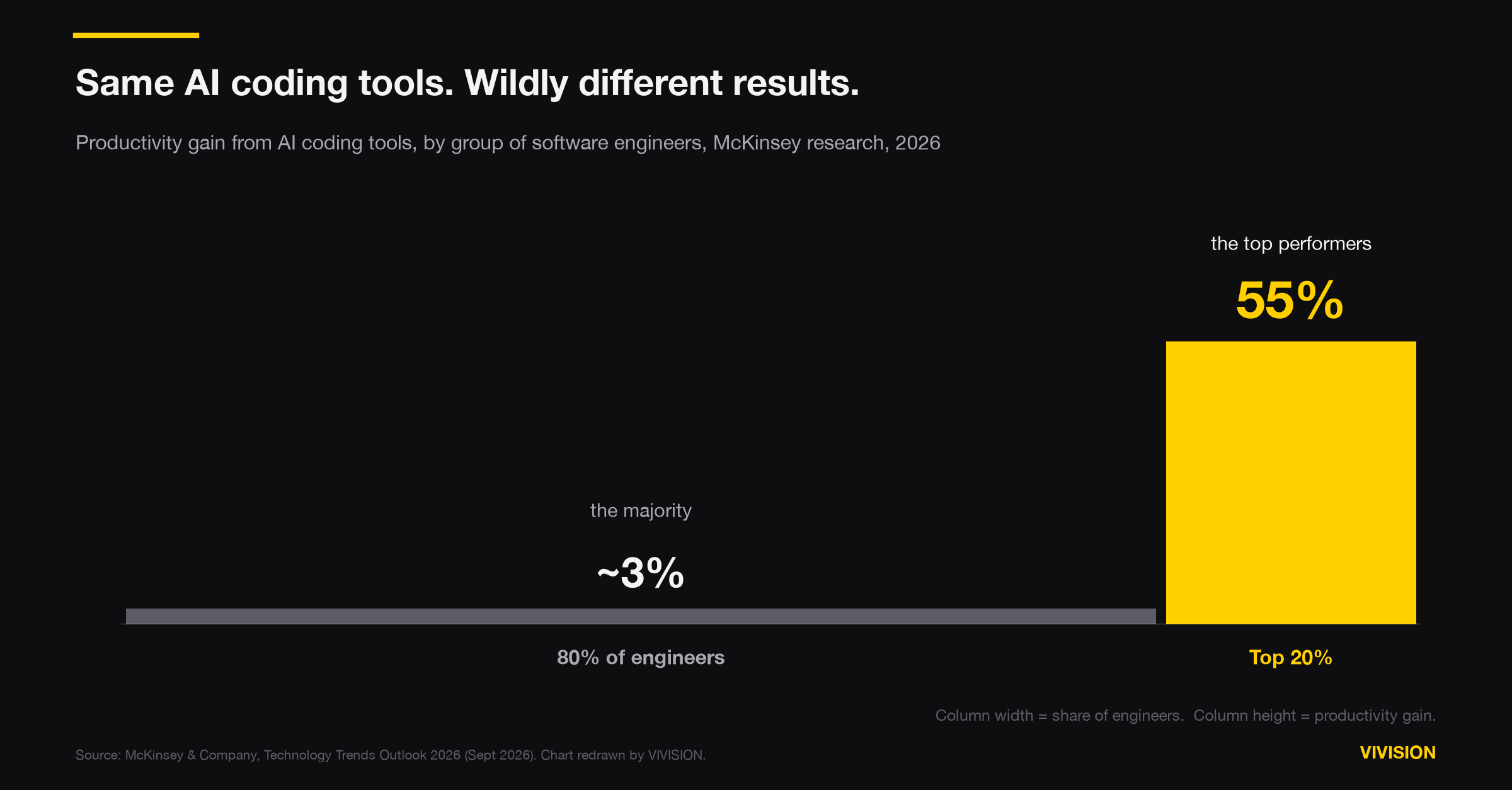
According to McKinsey, 80% of software engineers using AI tools see a productivity lift of around 3%. The top 20% see a 55% boost. McKinsey says getting to real success means nurturing those top performers and getting everyone else to adopt their winning practices. In other words, the upside is already inside many teams. It just hasn’t spread.
More code does not mean more product
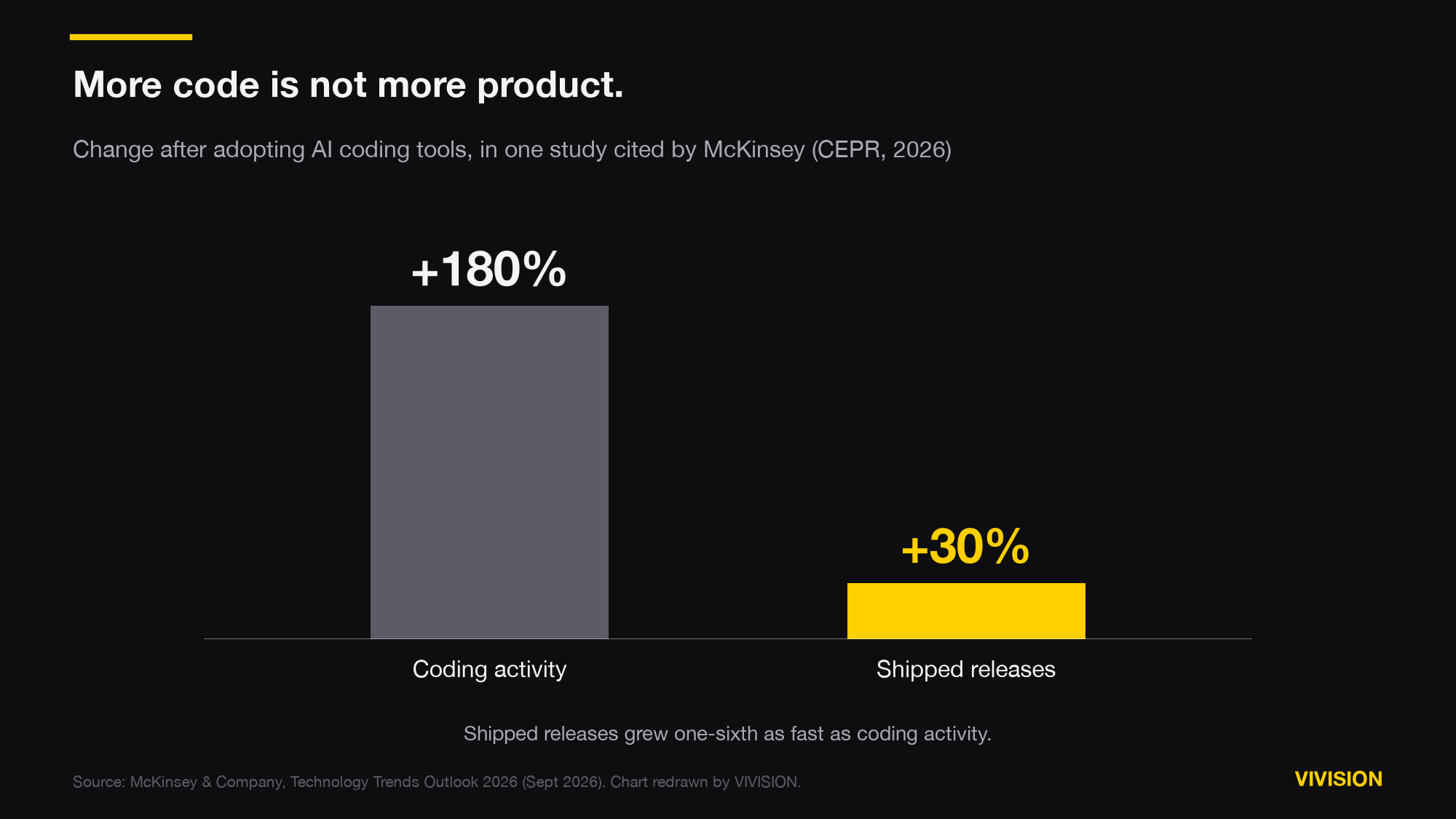
It is easy to measure activity. Lines written, pull requests opened, tickets closed. The report points to a study (Centre for Economic Policy Research, 2026) in which AI tools lifted coding activity by 180%, while shipped releases rose by only 30%. McKinsey also finds that in 30% of companies, productivity actually fell after teams started using agentic AI tools.
Speeding up the typing only fixes a small slice of the day
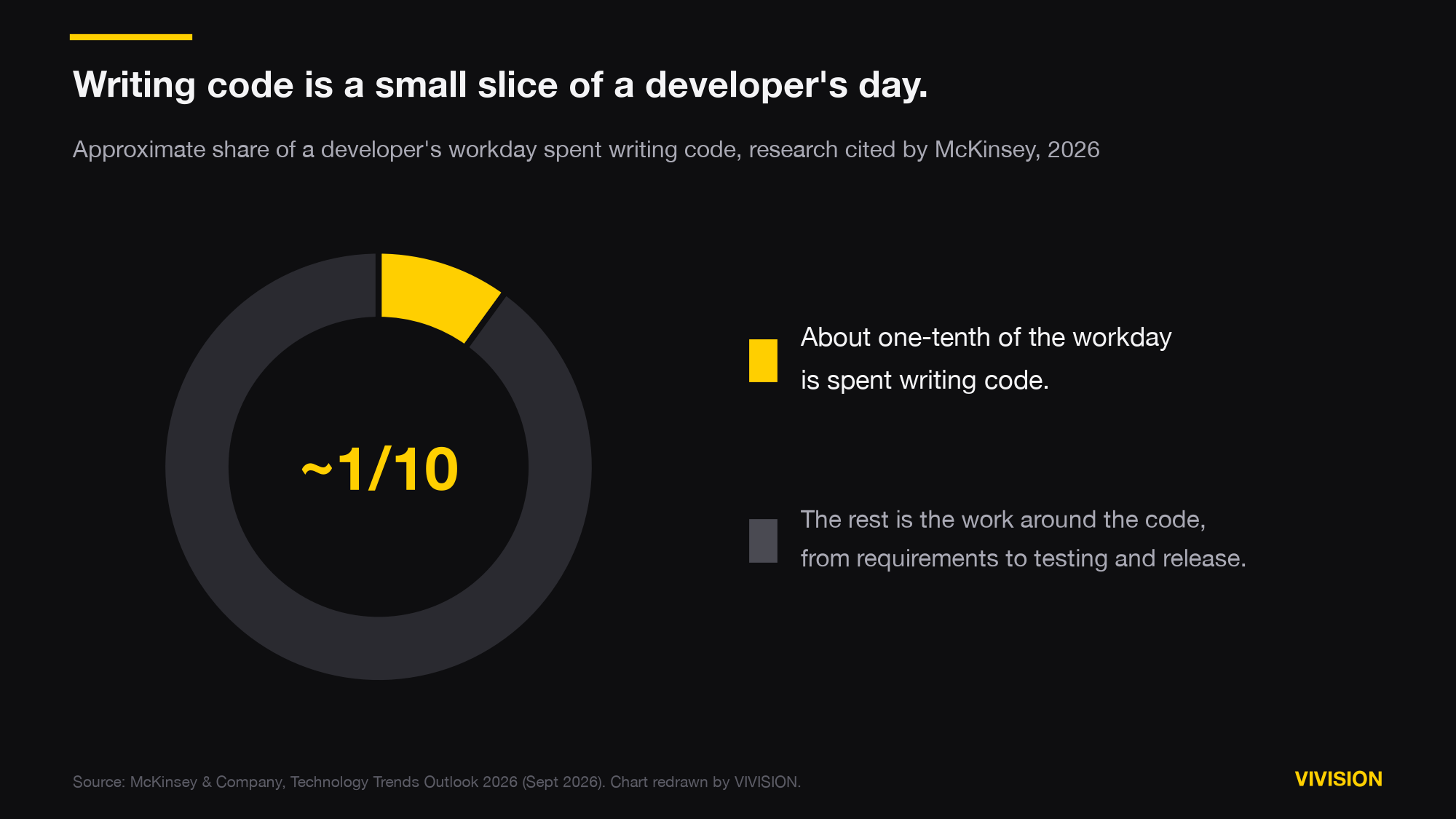
Research cited in the report finds developers spend only about one-tenth of their workday writing code. McKinsey’s point is that as coding gets automated, the bottlenecks shift to the edges: first deciding what to build, then checking whether what was built actually works. That is why the report stresses embedding AI across the whole product development life cycle, not just the coding step.
- A human team works through a backlog in two-week sprints.
- AI suggests the next line while a developer types.
- Adding capacity mostly means adding people.
- Software cost is mostly salaries.
- Work runs as a continuous loop, with agents drafting, testing and documenting between human reviews.
- Developers hand tasks to agents that can work overnight or across a weekend.
- Small human teams supervise many agents, defining the product, the architecture and the limits.
- Cost becomes labour plus AI usage, and token spend becomes a budget line to govern.
Five moves to spread the 55% across your team
This is VIVISION’s own playbook, built on the patterns McKinsey describes in top-performing organizations.
Ask your strongest AI users to show how they brief an agent, split a task and check the output. Turn it into a one-page team standard. The gap between 3% and 55% is mostly habits, and habits can be taught.
McKinsey notes product requirements now act as directions for agents to follow. A vague request produces fast, confident, wrong work. A clear one is the cheapest quality control you will ever buy.
If output doubles and review capacity doesn’t, work piles up waiting to be checked. McKinsey’s skills data shows continuous integration and delivery, the skills that move code safely into production, as the sharpest shortage in this trend. Invest there first.
McKinsey’s analysis shows top performers are six to seven times more likely to embed AI across four or more stages of the development life cycle. Think requirements, design, testing, release and documentation, not just the editor.
The report says the hard part is no longer generating code but making sure agents understand your codebase, policies and product history. Document how things work, and set a monthly AI usage budget per team so cost stays visible as usage grows.
Your developers may not trust the tools yet, and that is useful
The report cites the Stack Overflow 2025 Developer Survey: 46% of developers worldwide actively distrust AI tools’ accuracy, 33% trust them, and only 3% highly trust their outputs.
What this means for your kind of business
Quick answers
Does this mean we need fewer developers?
McKinsey describes the most advanced adopters moving toward smaller, highly leveraged teams, and notes Salesforce said it would not hire additional software engineers in 2025 after reporting productivity gains. For most growing businesses, our view is that the first win is shipping the backlog you could never get to, not cutting people. The roles that grow are the ones that define the product and check the work.
How far along are most companies?
McKinsey scores adoption at 3, “piloting”: most organizations have started pilots, more are moving to scale, and technology companies are furthest ahead. Businesses with documented processes and searchable knowledge are better placed to move quickly, according to the report.
What new costs should I expect?
Usage-based AI costs. McKinsey notes token spend and inference costs are moving from a rounding error to a material line item, and that AI now accounts for a third of companies’ spending to introduce new capabilities. Put a budget and an owner on it early.
Are there security risks?
Yes. The report warns that more autonomy brings new risks and calls for layered controls: access limits, isolation, monitoring, human oversight, containment and recovery. Decide what an agent may change before it starts, not after.
VIVISION runs a delivery flow review. We map how a request becomes a released feature in your business, measure where work waits, and find the practices your best people already use with AI. Then we set up the pieces that let the whole team benefit: a clear requirement template, a testing gate, an AI usage budget and one outcome metric.
If you work through an agency, we help you rewrite the brief and the contract so faster delivery shows up for you, not only for them.
Your Monday checklist
- [ ]Pick one outcome metric (releases per month or request-to-release time) and record today’s number.
- [ ]Ask who on the team gets the most from AI tools. Book 30 minutes to watch how they work.
- [ ]Count how many stages of your delivery process use AI today. Aim for four.
- [ ]Check what automatic tests run before code goes live. If the answer is “not many”, start there.
- [ ]Set a monthly AI usage budget and name its owner.
Paying for AI coding tools but not seeing it in what ships?
Tell us how a request becomes a release in your business. We will show you where the time is really going.
Source: McKinsey & Company, “Technology Trends Outlook 2026” (Sixth edition, September 2026), Agentic software development chapter. All statistics are McKinsey’s, including McKinsey research and labor-market data and third-party data the report cites (Centre for Economic Policy Research study, Stack Overflow 2025 Developer Survey, and research on developer time use). Charts were redrawn by VIVISION from the published figures. The “VIVISION insight” sections, the top-fifth playbook, the business-type cards, the quick-answer opinions, the checklist and “what we do for clients” are VIVISION’s own views and are not McKinsey’s.
Copyright in the original report belongs to McKinsey & Company. Cover photo: Haberdoedas on Unsplash.